
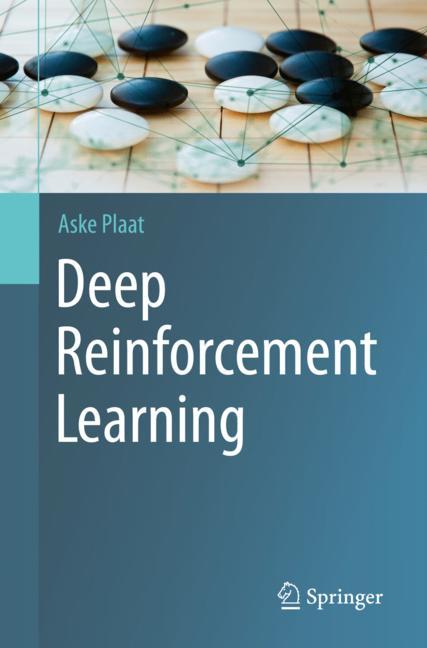
Deep Reinforcement Learning
☆☆☆☆☆
(0 reviews)
Lowest price (incl. delivery)
7 893,00 JPY
Typical price925,54 PLN
Lowest (90 days)45,50 PLN
Offers3
Last updated1주 전
Price history (90 days)
Full history
2026-08-08
2026-08-15
| 업데이트 일시 | 가격 |
|---|---|
| 2026-08-08 | 45,50 |
| 2026-08-15 | 57,19 |
| 판매자 | Product price | Delivery | 합계 | 재고 여부 | Updated | |
|---|---|---|---|---|---|---|
| SP SpringerNatureLink Shop INT | 7 864,00 JPY | 29,00 JPY | 7 893,00 JPY | 구매 가능 | 5일 전 | View offer |
| SP Springer Nature Author | 7 864,00 JPY | free | 7 864,00 JPY | 구매 가능 | 1주 전 | View offer |
| SP SpringerNatureLink Shop INT | 60,49 EUR | 29,00 EUR | 89,49 EUR | 구매 가능 | 6일 전 | View offer |
가격과 재고 여부는 변경될 수 있습니다. 마지막 업데이트: 08.08.2026 21:10.
EAN
9789811906374
Springer Nature
0,0
☆☆☆☆☆
0 reviews
5★
0%
4★
0%
3★
0%
2★
0%
1★
0%
Product reviews
No reviews yet — be the first!
Deep reinforcement learning has attracted considerable attention recently. Impressive results have been achieved in such diverse fields as autonomous driving, game playing, molecular recombination, and robotics. In all these fields, computer programs have taught themselves to understand problems that were previously considered to be very difficult. In the game of Go, the program AlphaGo has even learned to outmatch three of the world’s leading players.Deep reinforcement learning takes its inspiration from the fields of biology and psychology. Biology has inspired the creation of artificial neural networks and deep learning, while psychology studies how animals and humans learn, and how subjects’ desired behavior can be reinforced with positive and negative stimuli. When we see how reinforcement learning teaches a simulated robot to walk, we are reminded of how children learn, through playful exploration. Techniques that are inspired by biology and psychology work amazingly well in computers: animal behavior and the structure of the brain as new blueprints for science and engineering. In fact, computers truly seem to possess aspects of human behavior; as such, this field goes to the heart of the dream of artificial intelligence. These research advances have not gone unnoticed by educators. Many universities have begun offering courses on the subject of deep reinforcement learning. The aim of this book is to provide an overview of the field, at the proper level of detail for a graduate course in artificial intelligence. It covers the complete field, from the basic algorithms of Deep Q-learning, to advanced topics such as multi-agent reinforcement learning and meta learning.
Similar products
 50 Years of Philosophy and Medicine
from $107.30
50 Years of Philosophy and Medicine
from $107.30
 Understanding Cybersecurity Law and Digital Privacy
from $122.63
Understanding Cybersecurity Law and Digital Privacy
from $122.63
 Decisions in International Trade and Logistics
from $122.63
Decisions in International Trade and Logistics
from $122.63
 Advances in Economic Measurement
from $122.63
Advances in Economic Measurement
from $122.63
 Nanomaterials
from $137.96
Nanomaterials
from $137.96
 Sustainable Scaffolds-based Strategies in Tissue Engineering and Regenerative Medicine
from $162.87
Sustainable Scaffolds-based Strategies in Tissue Engineering and Regenerative Medicine
from $162.87
 Narratives in Educational Research
from $162.87
Narratives in Educational Research
from $162.87
 Environmental Biology of the Young Chinese Sturgeon
from $210.78
Environmental Biology of the Young Chinese Sturgeon
from $210.78