
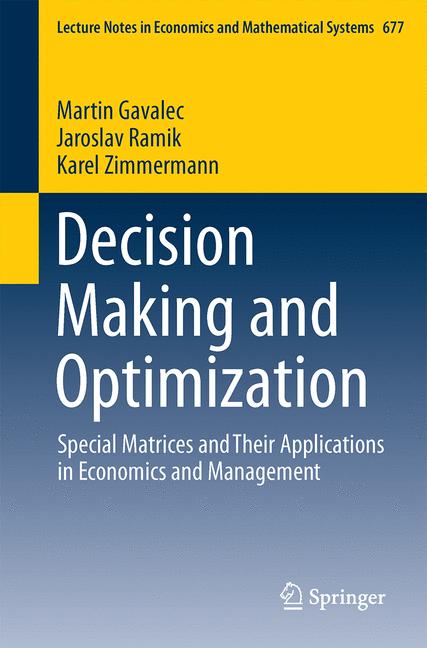
Decision Making and Optimization
☆☆☆☆☆
(0 reviews)
Lowest price (incl. delivery)
7 149,00 JPY
Typical price524,53 PLN
Lowest (90 days)35,99 PLN
Offers6
Last updated1주 전
Price history (90 days)
Full history
2026-08-08
2026-08-15
| 업데이트 일시 | 가격 |
|---|---|
| 2026-08-08 | 39,99 |
| 2026-08-14 | 35,99 |
| 2026-08-15 | 51,99 |
| 판매자 | Product price | Delivery | 합계 | 재고 여부 | Updated | |
|---|---|---|---|---|---|---|
| SP SpringerNatureLink Shop INT | 7 149,00 JPY | free | 7 149,00 JPY | 구매 가능 | 2일 전 | View offer |
| SP Springer Nature Author | 7 149,00 JPY | 25,00 JPY | 7 174,00 JPY | 구매 가능 | 1주 전 | View offer |
| SP SpringerNatureLink Shop INT | 49,99 USD | free | 49,99 USD | 구매 가능 | 2일 전 | View offer |
| SP SpringerNatureLink Shop INT | 54,99 USD | 19,00 USD | 73,99 USD | 구매 가능 | 2일 전 | View offer |
| SP SpringerNatureLink Shop INT | 54,99 USD | 15,00 USD | 69,99 USD | 구매 가능 | 2일 전 | View offer |
| SP SpringerNatureLink Shop INT | 59,00 EUR | 19,00 EUR | 78,00 EUR | 구매 가능 | 2일 전 | View offer |
가격과 재고 여부는 변경될 수 있습니다. 마지막 업데이트: 08.08.2026 23:08.
0,0
☆☆☆☆☆
0 reviews
5★
0%
4★
0%
3★
0%
2★
0%
1★
0%
Product reviews
No reviews yet — be the first!
The book is a benefit for graduate and postgraduate students in the areas of operations research, decision theory, optimization theory, linear algebra, interval analysis and fuzzy sets. The book will also be useful for the researchers in the respective areas. The first part of the book deals with decision making problems and procedures that have been established to combine opinions about alternatives related to different points of view. Procedures based on pairwise comparisons are thoroughly investigated. In the second part we investigate optimization problems where objective functions and constraints are characterized by extremal operators such as maximum, minimum or various triangular norms (t-norms). Matrices in max-min algebra are useful in applications such as automata theory, design of switching circuits, logic of binary relations, medical diagnosis, Markov chains, social choice, models of organizations, information systems, political systems and clustering. The input data in real problems are usually not exact and can be characterized by interval values.
Similar products
 50 Years of Philosophy and Medicine
from $107.30
50 Years of Philosophy and Medicine
from $107.30
 Understanding Cybersecurity Law and Digital Privacy
from $122.63
Understanding Cybersecurity Law and Digital Privacy
from $122.63
 Decisions in International Trade and Logistics
from $122.63
Decisions in International Trade and Logistics
from $122.63
 Advances in Economic Measurement
from $122.63
Advances in Economic Measurement
from $122.63
 Nanomaterials
from $137.96
Nanomaterials
from $137.96
 Sustainable Scaffolds-based Strategies in Tissue Engineering and Regenerative Medicine
from $162.87
Sustainable Scaffolds-based Strategies in Tissue Engineering and Regenerative Medicine
from $162.87
 Narratives in Educational Research
from $162.87
Narratives in Educational Research
from $162.87
 Environmental Biology of the Young Chinese Sturgeon
from $210.78
Environmental Biology of the Young Chinese Sturgeon
from $210.78