
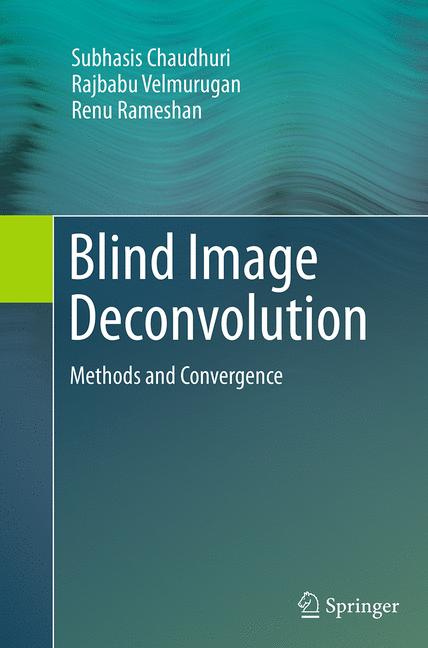
Blind Image Deconvolution
☆☆☆☆☆
(0 reviews)
Lowest price (incl. delivery)
7 164,00 JPY
Typical price494,76 PLN
Lowest (90 days)35,99 PLN
Offers6
Last updated1주 전
Price history (90 days)
Full history
2026-08-08
2026-08-15
| 업데이트 일시 | 가격 |
|---|---|
| 2026-08-08 | 39,99 |
| 2026-08-14 | 35,99 |
| 2026-08-15 | 51,99 |
| 판매자 | Product price | Delivery | 합계 | 재고 여부 | Updated | |
|---|---|---|---|---|---|---|
| SP SpringerNatureLink Shop INT | 7 149,00 JPY | 15,00 JPY | 7 164,00 JPY | 구매 가능 | 2일 전 | View offer |
| SP Springer Nature Author | 7 149,00 JPY | free | 7 149,00 JPY | 구매 가능 | 1주 전 | View offer |
| SP SpringerNatureLink Shop INT | 49,99 USD | 25,00 USD | 74,99 USD | 구매 가능 | 2일 전 | View offer |
| SP SpringerNatureLink Shop INT | 54,99 USD | free | 54,99 USD | 구매 가능 | 2일 전 | View offer |
| SP SpringerNatureLink Shop INT | 54,99 USD | free | 54,99 USD | 구매 가능 | 2일 전 | View offer |
| SP SpringerNatureLink Shop INT | 59,00 EUR | free | 59,00 EUR | 구매 가능 | 2일 전 | View offer |
가격과 재고 여부는 변경될 수 있습니다. 마지막 업데이트: 08.08.2026 23:08.
0,0
☆☆☆☆☆
0 reviews
5★
0%
4★
0%
3★
0%
2★
0%
1★
0%
Product reviews
No reviews yet — be the first!
Blind deconvolution is a classical image processing problem which has been investigated by a large number of researchers over the last four decades. The purpose of this monograph is not to propose yet another method for blind image restoration. Rather the basic issue of deconvolvability has been explored from a theoretical view point. Some authors claim very good results while quite a few claim that blind restoration does not work. The authors clearly detail when such methods are expected to work and when they will not. In order to avoid the assumptions needed for convergence analysis in the Fourier domain, the authors use a general method of convergence analysis used for alternate minimization based on three point and four point properties of the points in the image space. The authors prove that all points in the image space satisfy the three point property and also derive the conditions under which four point property is satisfied. This provides the conditions under which alternate minimization for blind deconvolution converges with a quadratic prior. Since the convergence properties depend on the chosen priors, one should design priors that avoid trivial solutions. Hence, a sparsity based solution is also provided for blind deconvolution, by using image priors having a cost that increases with the amount of blur, which is another way to prevent trivial solutions in joint estimation. This book will be a highly useful resource to the researchers and academicians in the specific area of blind deconvolution.
Similar products
 50 Years of Philosophy and Medicine
from $107.30
50 Years of Philosophy and Medicine
from $107.30
 Understanding Cybersecurity Law and Digital Privacy
from $122.63
Understanding Cybersecurity Law and Digital Privacy
from $122.63
 Decisions in International Trade and Logistics
from $122.63
Decisions in International Trade and Logistics
from $122.63
 Advances in Economic Measurement
from $122.63
Advances in Economic Measurement
from $122.63
 Nanomaterials
from $137.96
Nanomaterials
from $137.96
 Sustainable Scaffolds-based Strategies in Tissue Engineering and Regenerative Medicine
from $162.87
Sustainable Scaffolds-based Strategies in Tissue Engineering and Regenerative Medicine
from $162.87
 Narratives in Educational Research
from $162.87
Narratives in Educational Research
from $162.87
 Environmental Biology of the Young Chinese Sturgeon
from $210.78
Environmental Biology of the Young Chinese Sturgeon
from $210.78