
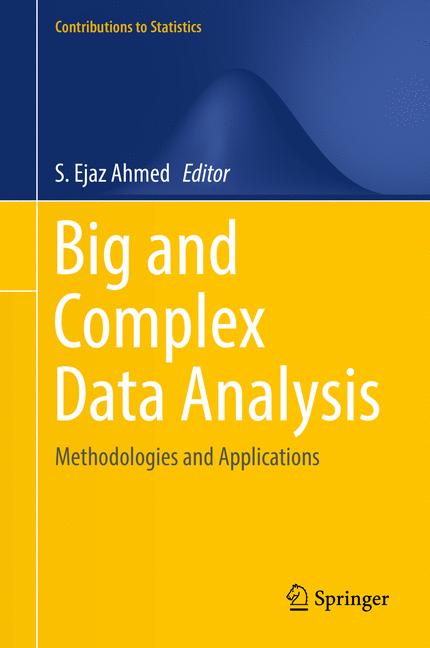
Big and Complex Data Analysis
☆☆☆☆☆
(0 reviews)
Lowest price (incl. delivery)
10 324,00 JPY
Typical price79,75 PLN
Lowest (90 days)63,99 PLN
Offers3
Last updated4일 전
Price history (90 days)
Full history
2026-08-08
2026-08-15
| 업데이트 일시 | 가격 |
|---|---|
| 2026-08-08 | 85,00 |
| 2026-08-15 | 63,99 |
| 판매자 | Product price | Delivery | 합계 | 재고 여부 | Updated | |
|---|---|---|---|---|---|---|
| SP SpringerNatureLink Shop INT | 10 295,00 JPY | 29,00 JPY | 10 324,00 JPY | 구매 가능 | 4일 전 | View offer |
| SP SpringerNatureLink Shop INT | 85,00 EUR | 29,00 EUR | 114,00 EUR | 구매 가능 | 4일 전 | View offer |
| SP Springer Nature Author | 85,00 EUR | 25,00 EUR | 110,00 EUR | 구매 가능 | 1주 전 | View offer |
가격과 재고 여부는 변경될 수 있습니다. 마지막 업데이트: 15.08.2026 07:56.
EAN
9783319415734
Springer Nature
0,0
☆☆☆☆☆
0 reviews
5★
0%
4★
0%
3★
0%
2★
0%
1★
0%
Product reviews
No reviews yet — be the first!
This volume conveys some of the surprises, puzzles and success stories in high-dimensional and complex data analysis and related fields. Its peer-reviewed contributions showcase recent advances in variable selection, estimation and prediction strategies for a host of useful models, as well as essential new developments in the field. The continued and rapid advancement of modern technology now allows scientists to collect data of increasingly unprecedented size and complexity. Examples include epigenomic data, genomic data, proteomic data, high-resolution image data, high-frequency financial data, functional and longitudinal data, and network data. Simultaneous variable selection and estimation is one of the key statistical problems involved in analyzing such big and complex data. The purpose of this book is to stimulate research and foster interaction between researchers in the area of high-dimensional data analysis. More concretely, its goals are to: 1) highlight and expand the breadth of existing methods in big data and high-dimensional data analysis and their potential for the advancement of both the mathematical and statistical sciences; 2) identify important directions for future research in the theory of regularization methods, in algorithmic development, and in methodologies for different application areas; and 3) facilitate collaboration between theoretical and subject-specific researchers.
Similar products
 50 Years of Philosophy and Medicine
from $107.30
50 Years of Philosophy and Medicine
from $107.30
 Understanding Cybersecurity Law and Digital Privacy
from $122.63
Understanding Cybersecurity Law and Digital Privacy
from $122.63
 Decisions in International Trade and Logistics
from $122.63
Decisions in International Trade and Logistics
from $122.63
 Advances in Economic Measurement
from $122.63
Advances in Economic Measurement
from $122.63
 Nanomaterials
from $137.96
Nanomaterials
from $137.96
 Sustainable Scaffolds-based Strategies in Tissue Engineering and Regenerative Medicine
from $162.87
Sustainable Scaffolds-based Strategies in Tissue Engineering and Regenerative Medicine
from $162.87
 Narratives in Educational Research
from $162.87
Narratives in Educational Research
from $162.87
 Environmental Biology of the Young Chinese Sturgeon
from $210.78
Environmental Biology of the Young Chinese Sturgeon
from $210.78