
Applied General Equilibrium
☆☆☆☆☆
(0 reviews)
Lowest price (incl. delivery)
12 154,00 JPY
Typical price500,01 PLN
Lowest (90 days)27,38 PLN
Offers4
Last updated1주 전
Price history (90 days)
Full history
2026-08-08
2026-08-15
| 업데이트 일시 | 가격 |
|---|---|
| 2026-08-08 | 27,38 |
| 2026-08-15 | 88,39 |
| 판매자 | Product price | Delivery | 합계 | 재고 여부 | Updated | |
|---|---|---|---|---|---|---|
| SP SpringerNatureLink Shop INT | 12 154,00 JPY | free | 12 154,00 JPY | 구매 가능 | 3일 전 | View offer |
| SP Springer Nature Author | 12 154,00 JPY | 29,00 JPY | 12 183,00 JPY | 구매 가능 | 1주 전 | View offer |
| VI VitalSource | 370,01 ZAR | free | 370,01 ZAR | 구매 가능 | 1주 전 | View offer |
| SP SpringerNatureLink Shop INT | 93,49 EUR | 29,00 EUR | 122,49 EUR | 구매 가능 | 3일 전 | View offer |
가격과 재고 여부는 변경될 수 있습니다. 마지막 업데이트: 08.08.2026 21:39.
EAN
9783662548929
Springer Nature
0,0
☆☆☆☆☆
0 reviews
5★
0%
4★
0%
3★
0%
2★
0%
1★
0%
Product reviews
No reviews yet — be the first!
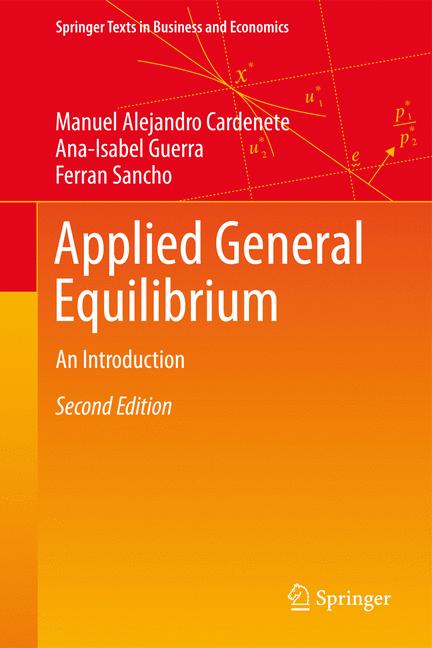
This advanced textbook provides a straightforward but comprehensive introduction to applied general equilibrium modeling. General equilibrium is the backbone of modern economic analysis, which is why generation after generation of economics students have been introduced to it. As an analytical tool, general equilibrium can provide one of the most complete views of a given economy, as it incorporates all economic agents (households, firms, government and the foreign sector) in an integrated way that explicitly reveals the interplay of economic forces—supply and demand—and the balancing role of prices. Applied general equilibrium goes one step further in modeling, since it entails the integration of microeconomic theory, data handling and computing. This integration is essential for successful empirical modeling, but also involves various abilities that are not found in standard books. This book fills the gap, providing advanced students with the required tools, from the construction of consistent and applicable general equilibrium models to the interpretation of the results that ensue from the adoption of policies. This second edition expands the range of topics covered, including: indispensable general equilibrium theory, step-by-step model design, incremental model extensions, a wealth of sample computer code, procedures for constructing economic databases, database adjustments and database updating algorithms, numerical model calibration, policy strategies and their trade-offs and welfare effects, and a discussion of empirical policy examples.
Similar products
 50 Years of Philosophy and Medicine
from $107.30
50 Years of Philosophy and Medicine
from $107.30
 Understanding Cybersecurity Law and Digital Privacy
from $122.63
Understanding Cybersecurity Law and Digital Privacy
from $122.63
 Decisions in International Trade and Logistics
from $122.63
Decisions in International Trade and Logistics
from $122.63
 Advances in Economic Measurement
from $122.63
Advances in Economic Measurement
from $122.63
 Nanomaterials
from $137.96
Nanomaterials
from $137.96
 Sustainable Scaffolds-based Strategies in Tissue Engineering and Regenerative Medicine
from $162.87
Sustainable Scaffolds-based Strategies in Tissue Engineering and Regenerative Medicine
from $162.87
 Narratives in Educational Research
from $162.87
Narratives in Educational Research
from $162.87
 Environmental Biology of the Young Chinese Sturgeon
from $210.78
Environmental Biology of the Young Chinese Sturgeon
from $210.78