
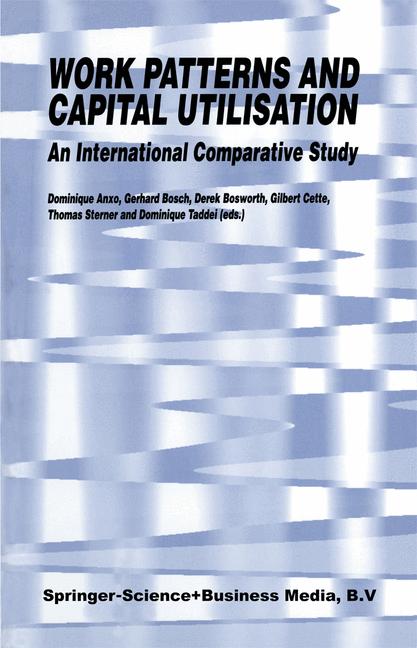
Work Patterns and Capital Utilisation
☆☆☆☆☆
(0 reviews)
Lowest price (incl. delivery)
7 178,00 JPY
Typical price416,51 PLN
Lowest (90 days)44,99 PLN
Offers6
Last updated1週間前
Price history (90 days)
Full history
2026-08-08
2026-08-15
| 更新日時 | 価格 |
|---|---|
| 2026-08-08 | 49,99 |
| 2026-08-14 | 44,99 |
| 2026-08-15 | 51,99 |
| 販売者 | Product price | Delivery | 合計 | 在庫状況 | Updated | |
|---|---|---|---|---|---|---|
| SP SpringerNatureLink Shop INT | 7 149,00 JPY | 29,00 JPY | 7 178,00 JPY | 在庫あり | 6日前 | View offer |
| SP Springer Nature Author | 7 149,00 JPY | free | 7 149,00 JPY | 在庫あり | 1週間前 | View offer |
| SP SpringerNatureLink Shop INT | 49,99 USD | free | 49,99 USD | 在庫あり | 6日前 | View offer |
| SP SpringerNatureLink Shop INT | 54,99 USD | 25,00 USD | 79,99 USD | 在庫あり | 6日前 | View offer |
| SP SpringerNatureLink Shop INT | 54,99 USD | 19,00 USD | 73,99 USD | 在庫あり | 6日前 | View offer |
| SP SpringerNatureLink Shop INT | 59,00 EUR | free | 59,00 EUR | 在庫あり | 6日前 | View offer |
価格や在庫状況は変更される場合があります。 最終更新: 08.08.2026 23:14.
0,0
☆☆☆☆☆
0 reviews
5★
0%
4★
0%
3★
0%
2★
0%
1★
0%
Product reviews
No reviews yet — be the first!
Edmond Malinvaud This book provides a most welcome survey of what statisticians and economists know about an aspect of production that is difficult to precisely characterize but matters a lot for both its importance on economic performance and its social implications. That such a survey is timely cannot be overemphasized; the point is well argued in the introduction to the book, which shows how discussions of the last decades stressed the importance of capital operating time as an economic variable in a series of distinct but interrelated topics, from growth theory to employment policies. Nowadays still more than ever in the past, production not only requires capital as well as labour but also depends on varied and complex forms of work organization, which tie more or less closely to one another the uses of the two main factors. In industry and services labour needs many pieces of capital for efficient production, some operating permanently others assisting when needed. Many, even among the most modem equipments, cannot well function without constant guidance or control by human labour. The cost of interrupting some industrial processes is so high as to impose continuous operation. The timing for the provision of many services has to be patterned in accordance with the rhythms of activities or requirements of those demanding these services, and so on. This interplay is so complex that its particularities were, and still are most often, fully neglected in statistical information and in economic analysis.
Similar products
 50 Years of Philosophy and Medicine
from $107.30
50 Years of Philosophy and Medicine
from $107.30
 Understanding Cybersecurity Law and Digital Privacy
from $122.63
Understanding Cybersecurity Law and Digital Privacy
from $122.63
 Decisions in International Trade and Logistics
from $122.63
Decisions in International Trade and Logistics
from $122.63
 Advances in Economic Measurement
from $122.63
Advances in Economic Measurement
from $122.63
 Nanomaterials
from $137.96
Nanomaterials
from $137.96
 Sustainable Scaffolds-based Strategies in Tissue Engineering and Regenerative Medicine
from $162.87
Sustainable Scaffolds-based Strategies in Tissue Engineering and Regenerative Medicine
from $162.87
 Narratives in Educational Research
from $162.87
Narratives in Educational Research
from $162.87
 Environmental Biology of the Young Chinese Sturgeon
from $210.78
Environmental Biology of the Young Chinese Sturgeon
from $210.78