
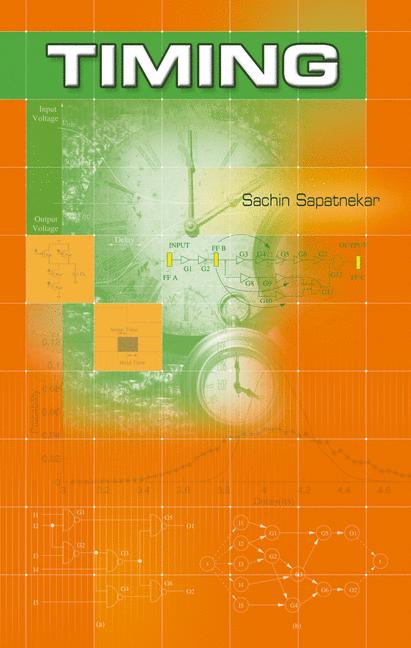
Timing
☆☆☆☆☆
(0 reviews)
Lowest price (incl. delivery)
169,00 USD
Typical price178,75 PLN
Lowest (90 days)169,00 PLN
Offers2
Last updated5日前
Price history (90 days)
Full history
2026-08-08
2026-08-15
| 更新日時 | 価格 |
|---|---|
| 2026-08-08 | 169,00 |
| 2026-08-15 | 188,50 |
| 販売者 | Product price | Delivery | 合計 | 在庫状況 | Updated | |
|---|---|---|---|---|---|---|
| SP Springer Nature Author | 169,00 USD | free | 169,00 USD | 在庫あり | 1週間前 | View offer |
| SP SpringerNatureLink Shop INT | 188,50 EUR | 25,00 EUR | 213,50 EUR | 在庫あり | 5日前 | View offer |
価格や在庫状況は変更される場合があります。 最終更新: 15.08.2026 06:39.
EAN
9781402080227
Springer Nature
0,0
☆☆☆☆☆
0 reviews
5★
0%
4★
0%
3★
0%
2★
0%
1★
0%
Product reviews
No reviews yet — be the first!
Statistical timing analysis is an area of growing importance in nanometer te- nologies‚ as the uncertainties associated with process and environmental var- tions increase‚ and this chapter has captured some of the major efforts in this area. This remains a very active field of research‚ and there is likely to be a great deal of new research to be found in conferences and journals after this book is published. In addition to the statistical analysis of combinational circuits‚ a good deal of work has been carried out in analyzing the effect of variations on clock skew. Although we will not treat this subject in this book‚ the reader is referred to [LNPS00‚ HN01‚ JH01‚ ABZ03a] for details. 7 TIMING ANALYSIS FOR SEQUENTIAL CIRCUITS 7.1 INTRODUCTION A general sequential circuit is a network of computational nodes (gates) and memory elements (registers). The computational nodes may be conceptualized as being clustered together in an acyclic network of gates that forms a c- binational logic circuit. A cyclic path in the direction of signal propagation 1 is permitted in the sequential circuit only if it contains at least one register . In general, it is possible to represent any sequential circuit in terms of the schematic shown in Figure 7.1, which has I inputs, O outputs and M registers. The registers outputs feed into the combinational logic which, in turn, feeds the register inputs. Thus, the combinational logic has I + M inputs and O + M outputs.
Similar products
 Gamma Knife Neurosurgery in the Management of Intracranial Disorders
from $210.78
Gamma Knife Neurosurgery in the Management of Intracranial Disorders
from $210.78
 SDGs in Construction Economics and Organization
from $210.78
SDGs in Construction Economics and Organization
from $210.78
 Emerging Therapies in Neurorehabilitation III
from $210.78
Emerging Therapies in Neurorehabilitation III
from $210.78
 Ground Improvement Techniques
from $220.36
Ground Improvement Techniques
from $220.36
 Anomaly Detection in Video Surveillance
from $220.36
Anomaly Detection in Video Surveillance
from $220.36
 Mechanism and Machine Science
from $287.42
Mechanism and Machine Science
from $287.42
 Protein-Protein Interactions as New Drug Targets
from $287.42
Protein-Protein Interactions as New Drug Targets
from $287.42
 Proceedings of the 7th International Conference of Transportation Research Group of India (CTRG 2023
from $287.42
Proceedings of the 7th International Conference of Transportation Research Group of India (CTRG 2023
from $287.42