
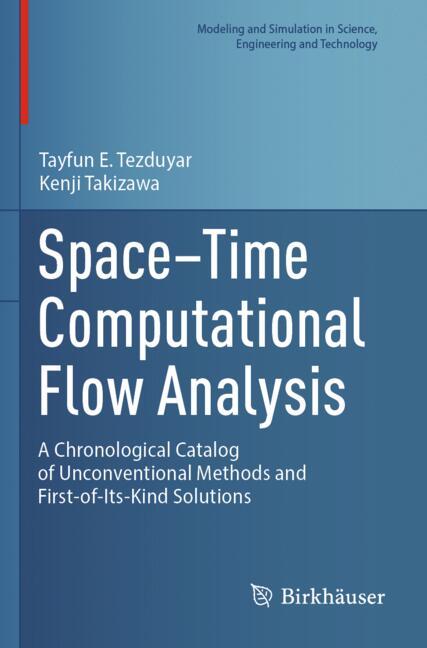
Space–Time Computational Flow Analysis
☆☆☆☆☆
(0 reviews)
Lowest price (incl. delivery)
184,99 USD
Typical price172,48 PLN
Lowest (90 days)139,09 PLN
Offers6
Last updated1日前
Price history (90 days)
Full history
2026-08-08
2026-08-15
| 更新日時 | 価格 |
|---|---|
| 2026-08-08 | 139,09 |
| 2026-08-15 | 149,99 |
| 販売者 | Product price | Delivery | 合計 | 在庫状況 | Updated | |
|---|---|---|---|---|---|---|
| SP SpringerNatureLink Shop INT | 169,99 USD | 15,00 USD | 184,99 USD | 在庫あり | 1日前 | View offer |
| SP SpringerNatureLink Shop INT | 169,99 USD | 15,00 USD | 184,99 USD | 在庫あり | 1日前 | View offer |
| SP SpringerNatureLink Shop INT | 199,99 USD | free | 199,99 USD | 在庫あり | 1日前 | View offer |
| SP SpringerNatureLink Shop INT | 199,99 USD | 25,00 USD | 224,99 USD | 在庫あり | 1日前 | View offer |
| SP Springer Nature Author | 199,99 USD | 25,00 USD | 224,99 USD | 在庫あり | 1週間前 | View offer |
| SP SpringerNatureLink Shop INT | 186,99 EUR | 19,00 EUR | 205,99 EUR | 在庫あり | 1日前 | View offer |
価格や在庫状況は変更される場合があります。 最終更新: 15.08.2026 06:38.
0,0
☆☆☆☆☆
0 reviews
5★
0%
4★
0%
3★
0%
2★
0%
1★
0%
Product reviews
No reviews yet — be the first!
Space–Time Computational Flow Analysis (STCFA) was developed in 1990 in the context of flows with moving boundaries and interfaces, which is a wide class of problems that includes fluid–particle interactions, fluid–structure interactions (FSI), and free-surface and multi-fluid flows. It is a computational framework made of unconventional methods, which have evolved over the years as more unconventional methods were introduced to increase its scope and accuracy. It brought first-of-its-kind solutions in many classes of problems, including fluid–particle interactions in particle-laden flows, FSI in parachute aerodynamics, flapping-wing aerodynamics of an actual locust, ventricle-valve-aorta flow analysis, and car and tire aerodynamics. With these successes in so many classes of problems, the STCFA has reached a level of remarkable sophistication, scope, and practical value. This monograph presents, for the first time, a chronological catalog of STCFA methods and solutions from their development to the present. Part I focuses on the STCFA in the context of finite element analysis, and Part II in the context of isogeometric analysis. The methods presented include complementary general-purpose methods that were introduced in the evolution of STCFA. All researchers working on or interested in space–time computations in fluid mechanics, FSI, and solid mechanics, including graduate students, will benefit from the wealth of powerful computational methods and impressive solutions they will find in the book.
Similar products
 50 Years of Philosophy and Medicine
from $107.30
50 Years of Philosophy and Medicine
from $107.30
 Understanding Cybersecurity Law and Digital Privacy
from $122.63
Understanding Cybersecurity Law and Digital Privacy
from $122.63
 Decisions in International Trade and Logistics
from $122.63
Decisions in International Trade and Logistics
from $122.63
 Advances in Economic Measurement
from $122.63
Advances in Economic Measurement
from $122.63
 Nanomaterials
from $137.96
Nanomaterials
from $137.96
 Sustainable Scaffolds-based Strategies in Tissue Engineering and Regenerative Medicine
from $162.87
Sustainable Scaffolds-based Strategies in Tissue Engineering and Regenerative Medicine
from $162.87
 Narratives in Educational Research
from $162.87
Narratives in Educational Research
from $162.87
 Environmental Biology of the Young Chinese Sturgeon
from $210.78
Environmental Biology of the Young Chinese Sturgeon
from $210.78