
Self-Handicapping
☆☆☆☆☆
(0 reviews)
Lowest price (incl. delivery)
21 464,00 JPY
Typical price2 982,30 PLN
Lowest (90 days)129,99 PLN
Offers6
Last updated1週間前
Price history (90 days)
Full history
2026-08-08
2026-08-15
| 更新日時 | 価格 |
|---|---|
| 2026-08-08 | 129,99 |
| 2026-08-15 | 155,99 |
| 販売者 | Product price | Delivery | 合計 | 在庫状況 | Updated | |
|---|---|---|---|---|---|---|
| SP SpringerNatureLink Shop INT | 21 449,00 JPY | 15,00 JPY | 21 464,00 JPY | 在庫あり | 5日前 | View offer |
| SP Springer Nature Author | 21 449,00 JPY | 25,00 JPY | 21 474,00 JPY | 在庫あり | 1週間前 | View offer |
| SP SpringerNatureLink Shop INT | 149,99 USD | 15,00 USD | 164,99 USD | 在庫あり | 5日前 | View offer |
| SP SpringerNatureLink Shop INT | 169,99 USD | free | 169,99 USD | 在庫あり | 5日前 | View offer |
| SP SpringerNatureLink Shop INT | 169,99 USD | 19,00 USD | 188,99 USD | 在庫あり | 5日前 | View offer |
| SP SpringerNatureLink Shop INT | 177,00 EUR | 25,00 EUR | 202,00 EUR | 在庫あり | 5日前 | View offer |
価格や在庫状況は変更される場合があります。 最終更新: 08.08.2026 23:33.
0,0
☆☆☆☆☆
0 reviews
5★
0%
4★
0%
3★
0%
2★
0%
1★
0%
Product reviews
No reviews yet — be the first!
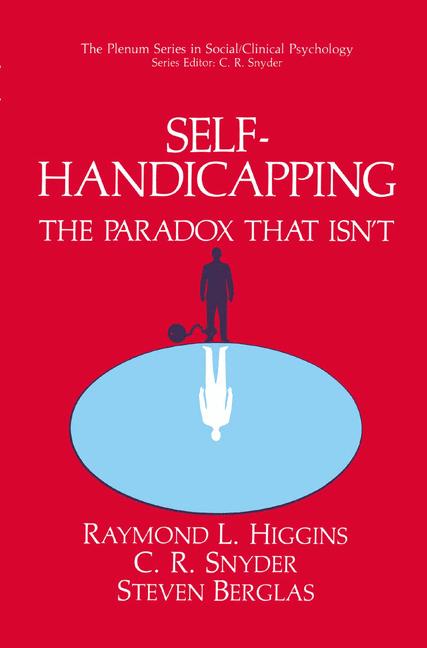
The concept of self-handicapping can be legitimately anchored in a vari ety of intellectual contexts, some old and some newer. As this volume reminds us, Alfred Adler was perhaps the first to articulate the signifi cance of various self-defeating claims and gestures for protecting the self concept. Thus the apparent paradox of "defeat" in the interests of "pro tection. " More recently (but still more than 30 years ago), Heider's "naive psychology" added attributional rhetoric to the description of self-defeat ing strategies. While predominantly cognitive in its thrust, the attribu tional approach incorporated several motivational influences-especially those involving egocentric concerns. Heider hardly violated our common sense when he suggested that people are inclined to attribute their performances in a self-serving manner: the good things I caused; the bad things were forced upon me. The notion of self-handicapping strategies, proposed by Berglas and myself a little more than a decade ago, capitalized on these homely truths while adding a particular proactive twist. We not only make ex cuses for our blunders; we plan our engagements and our situational choices so that self-protective excuses are unnecessary. In doing so, we use our attributional understanding to arrange things so that flawed and failing performances will not be interpreted in ways that threaten our self-esteem.
Similar products
 50 Years of Philosophy and Medicine
from $107.30
50 Years of Philosophy and Medicine
from $107.30
 Understanding Cybersecurity Law and Digital Privacy
from $122.63
Understanding Cybersecurity Law and Digital Privacy
from $122.63
 Decisions in International Trade and Logistics
from $122.63
Decisions in International Trade and Logistics
from $122.63
 Advances in Economic Measurement
from $122.63
Advances in Economic Measurement
from $122.63
 Nanomaterials
from $137.96
Nanomaterials
from $137.96
 Sustainable Scaffolds-based Strategies in Tissue Engineering and Regenerative Medicine
from $162.87
Sustainable Scaffolds-based Strategies in Tissue Engineering and Regenerative Medicine
from $162.87
 Narratives in Educational Research
from $162.87
Narratives in Educational Research
from $162.87
 Environmental Biology of the Young Chinese Sturgeon
from $210.78
Environmental Biology of the Young Chinese Sturgeon
from $210.78