
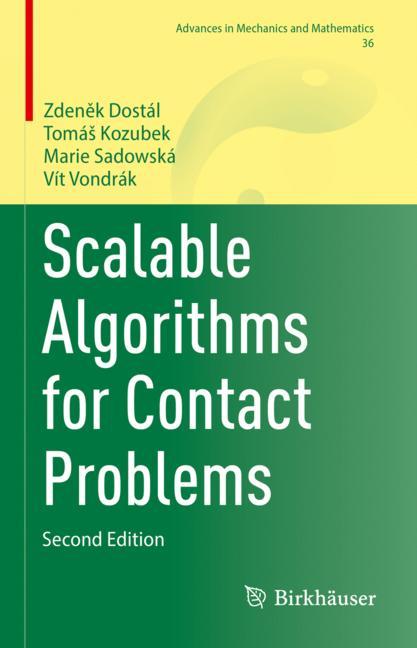
Scalable Algorithms for Contact Problems
☆☆☆☆☆
(0 reviews)
Lowest price (incl. delivery)
106,05 EUR
Typical price6 472,85 PLN
Lowest (90 days)95,87 PLN
Offers3
Last updated6日前
Price history (90 days)
Full history
2026-08-08
2026-08-15
| 更新日時 | 価格 |
|---|---|
| 2026-08-08 | 95,87 |
| 2026-08-15 | 106,05 |
| 販売者 | Product price | Delivery | 合計 | 在庫状況 | Updated | |
|---|---|---|---|---|---|---|
| SP SpringerNatureLink Shop INT | 106,05 EUR | free | 106,05 EUR | 在庫あり | 6日前 | View offer |
| SP SpringerNatureLink Shop INT | 18 303,00 JPY | free | 18 303,00 JPY | 在庫あり | 6日前 | View offer |
| SP Springer Nature Author | 18 303,00 JPY | 25,00 JPY | 18 328,00 JPY | 在庫あり | 1週間前 | View offer |
価格や在庫状況は変更される場合があります。 最終更新: 15.08.2026 05:04.
EAN
9783031335808
Springer Nature
0,0
☆☆☆☆☆
0 reviews
5★
0%
4★
0%
3★
0%
2★
0%
1★
0%
Product reviews
No reviews yet — be the first!
This book presents a comprehensive treatment of recently developed scalable algorithms for solving multibody contact problems of linear elasticity. The brand-new feature of these algorithms is their theoretically supported numerical scalability (i.e., asymptotically linear complexity) and parallel scalability demonstrated in solving problems discretized by billions of degrees of freedom. The theory covers solving multibody frictionless contact problems, contact problems with possibly orthotropic Tresca’s friction, and transient contact problems. In addition, it also covers BEM discretization, treating jumping coefficients, floating bodies, mortar non-penetration conditions, etc. This second edition includes updated content, including a new chapter on hybrid domain decomposition methods for huge contact problems. Furthermore, new sections describe the latest algorithm improvements, e.g., the fast reconstruction of displacements, the adaptive reorthogonalization of dual constraints, and an updated chapter on parallel implementation. Several chapters are extended to give an independent exposition of classical bounds on the spectrum of mass and dual stiffness matrices, a benchmark for Coulomb orthotropic friction, details of discretization, etc. The exposition is divided into four parts, the first of which reviews auxiliary linear algebra, optimization, and analysis. The most important algorithms and optimality results are presented in the third chapter. The presentation includes continuous formulation, discretization, domain decomposition, optimality results, and numerical experiments. The final part contains extensions to contact shape optimization, plasticity, and HPC implementation. Graduate students and researchers in mechanical engineering, computational engineering, and applied mathematics will find this book of great value and interest.
Similar products
 50 Years of Philosophy and Medicine
from $107.30
50 Years of Philosophy and Medicine
from $107.30
 Understanding Cybersecurity Law and Digital Privacy
from $122.63
Understanding Cybersecurity Law and Digital Privacy
from $122.63
 Decisions in International Trade and Logistics
from $122.63
Decisions in International Trade and Logistics
from $122.63
 Advances in Economic Measurement
from $122.63
Advances in Economic Measurement
from $122.63
 Nanomaterials
from $137.96
Nanomaterials
from $137.96
 Sustainable Scaffolds-based Strategies in Tissue Engineering and Regenerative Medicine
from $162.87
Sustainable Scaffolds-based Strategies in Tissue Engineering and Regenerative Medicine
from $162.87
 Narratives in Educational Research
from $162.87
Narratives in Educational Research
from $162.87
 Environmental Biology of the Young Chinese Sturgeon
from $210.78
Environmental Biology of the Young Chinese Sturgeon
from $210.78