
Redeveloping Tehran
☆☆☆☆☆
(0 reviews)
Lowest price (incl. delivery)
14 299,00 JPY
Typical price1 051,94 PLN
Lowest (90 days)71,50 PLN
Offers6
Last updated1週間前
Price history (90 days)
Full history
2026-08-08
2026-08-15
| 更新日時 | 価格 |
|---|---|
| 2026-08-08 | 84,99 |
| 2026-08-15 | 71,50 |
| 販売者 | Product price | Delivery | 合計 | 在庫状況 | Updated | |
|---|---|---|---|---|---|---|
| SP SpringerNatureLink Shop INT | 14 299,00 JPY | free | 14 299,00 JPY | 在庫あり | 2日前 | View offer |
| SP Springer Nature Author | 14 299,00 JPY | 15,00 JPY | 14 314,00 JPY | 在庫あり | 1週間前 | View offer |
| SP SpringerNatureLink Shop INT | 99,99 USD | 29,00 USD | 128,99 USD | 在庫あり | 2日前 | View offer |
| SP SpringerNatureLink Shop INT | 109,99 USD | 15,00 USD | 124,99 USD | 在庫あり | 2日前 | View offer |
| SP SpringerNatureLink Shop INT | 109,99 USD | 19,00 USD | 128,99 USD | 在庫あり | 2日前 | View offer |
| SP SpringerNatureLink Shop INT | 118,00 EUR | 15,00 EUR | 133,00 EUR | 在庫あり | 2日前 | View offer |
価格や在庫状況は変更される場合があります。 最終更新: 08.08.2026 23:20.
0,0
☆☆☆☆☆
0 reviews
5★
0%
4★
0%
3★
0%
2★
0%
1★
0%
Product reviews
No reviews yet — be the first!
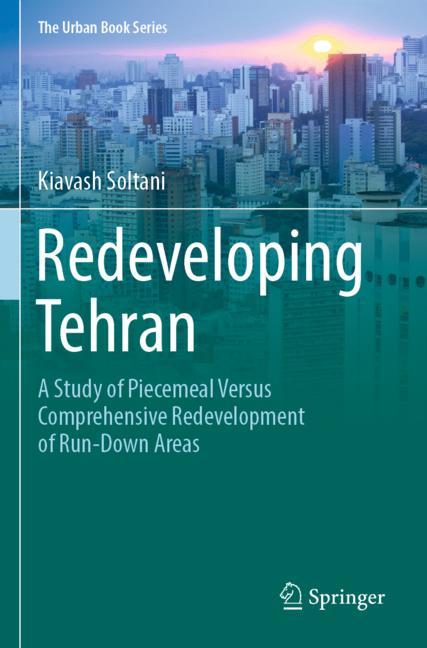
This book compares two urban regeneration models, namely piecemeal and comprehensive redevelopments. Tehran, like many cities in the developing world, on the one hand faces extensive deterioration in its inner-city neighbourhoods and on the other hand, faces rapid population growth. Urban regeneration is adapted as a policy that not only accommodates urban growth within the city boundaries, but also tackles the deterioration problems. This book tries to understand how these two redevelopment models operate in run-down neighbourhoods of Tehran, with a specific focus on developers’ behaviour regarding these two models. Two neighbourhoods that have undergone redevelopments in Tehran, one piecemeal and one comprehensive, are chosen as case studies. Utilising institutional analysis as a qualitative methodological approach, this book improves our understanding of the process of built environment production, as well as the role of developers and state in the development process.The book demonstrates that the development decision-making cannot be solely understood as the result of economic rationality, as it occurs within institutional contexts structured by dynamic needs and concerns of actors. In advancing institutional analysis, the research demonstrates the different approaches taken by developers, development organisations and planners as they engaged differently with the wider structures set by the government through different policies.
Similar products
 50 Years of Philosophy and Medicine
from $107.30
50 Years of Philosophy and Medicine
from $107.30
 Understanding Cybersecurity Law and Digital Privacy
from $122.63
Understanding Cybersecurity Law and Digital Privacy
from $122.63
 Decisions in International Trade and Logistics
from $122.63
Decisions in International Trade and Logistics
from $122.63
 Advances in Economic Measurement
from $122.63
Advances in Economic Measurement
from $122.63
 Nanomaterials
from $137.96
Nanomaterials
from $137.96
 Sustainable Scaffolds-based Strategies in Tissue Engineering and Regenerative Medicine
from $162.87
Sustainable Scaffolds-based Strategies in Tissue Engineering and Regenerative Medicine
from $162.87
 Narratives in Educational Research
from $162.87
Narratives in Educational Research
from $162.87
 Environmental Biology of the Young Chinese Sturgeon
from $210.78
Environmental Biology of the Young Chinese Sturgeon
from $210.78