
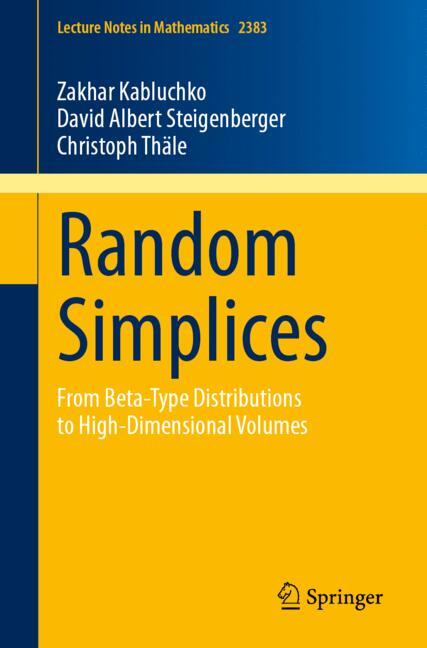
Random Simplices
☆☆☆☆☆
(0 reviews)
Lowest price (incl. delivery)
74,49 USD
Typical price48,75 PLN
Lowest (90 days)44,93 PLN
Offers2
Last updated1日前
| 販売者 | Product price | Delivery | 合計 | 在庫状況 | Updated | |
|---|---|---|---|---|---|---|
| SP SpringerNatureLink Shop INT | 59,49 USD | 15,00 USD | 74,49 USD | 在庫あり | 1日前 | View offer |
| SP Springer Nature Author | 59,49 USD | 25,00 USD | 84,49 USD | 在庫あり | 17時間前 | View offer |
価格や在庫状況は変更される場合があります。 最終更新: 08.08.2026 12:34.
0,0
☆☆☆☆☆
0 reviews
5★
0%
4★
0%
3★
0%
2★
0%
1★
0%
Product reviews
No reviews yet — be the first!
This book provides an introduction to the theory of random beta-type simplices and polytopes, exploring their connections to key research areas in stochastic and convex geometry. The random points defining the beta-type simplices, a class of random simplices introduced by Ruben and Miles, follow beta, beta-prime, or Gaussian distributions in the Euclidean space, and need not be identically distributed. A key tool in the analysis of these simplices, the so-called canonical decomposition, is presented here in a generalized form and is employed to derive explicit formulas for the moments of the volumes of beta-type simplices and to prove distributional representations for these volumes. Three independent approaches are described, including the original Ruben–Miles method. In addition, a version of the canonical decomposition for beta-type polytopes is provided, characterizing their typical faces as volume-weighted beta-type simplices. This is then applied to compute various expected functionals of beta-type polytopes, such as their volume, surface area and number of facets. The formulas for the moments of the volumes are also used to investigate several high-dimensional phenomena. Among these, a central limit theorem is established for the logarithmic volume of beta-type simplices in the high-dimensional limit. The canonical decomposition further motivates the study of beta-type distributions on affine Grassmannians, a subject to which the last chapter is dedicated. Largely self-contained, requiring minimal prior knowledge, the book connects these topics to a broad range of past and current research, serving as an excellent resource for graduate students and researchers seeking to engage with the field of stochastic and integral geometry.
Similar products
 Patient Safety Coaching
from $91.97
Patient Safety Coaching
from $91.97
 Ethnography and Diversity
from $69.30
Ethnography and Diversity
from $69.30
 Smart Villages
from $91.97
Smart Villages
from $91.97
 Nuclear Non-Proliferation in International Law - Volume VI
from $91.97
Nuclear Non-Proliferation in International Law - Volume VI
from $91.97
 The Price of Freedom
from $91.97
The Price of Freedom
from $91.97
 Eco-Social Policy in the OECD and the World Bank
from $91.97
Eco-Social Policy in the OECD and the World Bank
from $91.97
 Special Topics in Policing
from $122.58
Special Topics in Policing
from $122.58
 Music from the Heart
from $91.97
Music from the Heart
from $91.97