
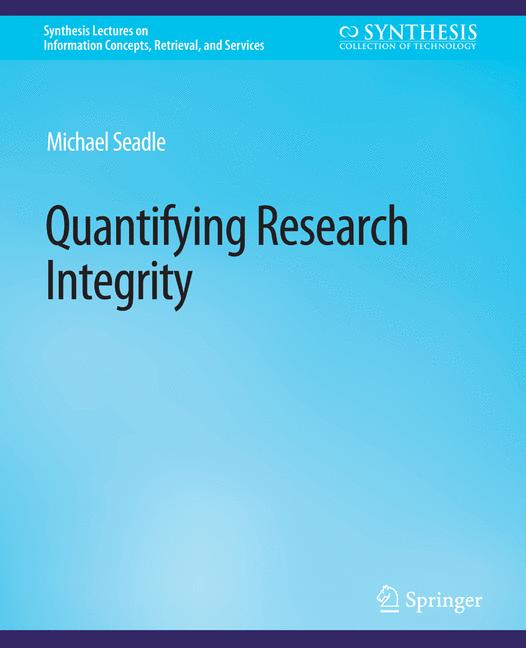
Quantifying Research Integrity
☆☆☆☆☆
(0 reviews)
Lowest price (incl. delivery)
63,99 USD
Typical price43,85 PLN
Lowest (90 days)37,44 PLN
Offers6
Last updated1週間前
Price history (90 days)
Full history
2026-08-08
2026-08-14
| 更新日時 | 価格 |
|---|---|
| 2026-08-08 | 37,44 |
| 2026-08-14 | 37,44 |
| 販売者 | Product price | Delivery | 合計 | 在庫状況 | Updated | |
|---|---|---|---|---|---|---|
| SP SpringerNatureLink Shop INT | 44,99 USD | 19,00 USD | 63,99 USD | 在庫あり | 2日前 | View offer |
| SP SpringerNatureLink Shop INT | 44,99 USD | 29,00 USD | 73,99 USD | 在庫あり | 2日前 | View offer |
| SP SpringerNatureLink Shop INT | 49,99 USD | 25,00 USD | 74,99 USD | 在庫あり | 2日前 | View offer |
| SP SpringerNatureLink Shop INT | 49,99 USD | 29,00 USD | 78,99 USD | 在庫あり | 2日前 | View offer |
| SP Springer Nature Author | 49,99 USD | 19,00 USD | 68,99 USD | 在庫あり | 1週間前 | View offer |
| SP SpringerNatureLink Shop INT | 48,14 EUR | 19,00 EUR | 67,14 EUR | 在庫あり | 2日前 | View offer |
価格や在庫状況は変更される場合があります。 最終更新: 08.08.2026 09:14.
0,0
☆☆☆☆☆
0 reviews
5★
0%
4★
0%
3★
0%
2★
0%
1★
0%
Product reviews
No reviews yet — be the first!
Institutions typically treat research integrity violations as black and white, right or wrong. The result is that the wide range of grayscale nuances that separate accident, carelessness, and bad practice from deliberate fraud and malpractice often get lost. This lecture looks at how to quantify the grayscale range in three kinds of research integrity violations: plagiarism, data falsification, and image manipulation. Quantification works best with plagiarism, because the essential one-to-one matching algorithms are well known and established tools for detecting when matches exist. Questions remain, however, of how many matching words of what kind in what location in which discipline constitute reasonable suspicion of fraudulent intent. Different disciplines take different perspectives on quantity and location. Quantification is harder with data falsification, because the original data are often not available, and because experimental replication remains surprisingly difficult. The same is true with image manipulation, where tools exist for detecting certain kinds of manipulations, but where the tools are also easily defeated. This lecture looks at how to prevent violations of research integrity from a pragmatic viewpoint, and at what steps can institutions and publishers take to discourage problems beyond the usual ethical admonitions. There are no simple answers, but two measures can help: the systematic use of detection tools and requiring original data and images. These alone do not suffice, but they represent a start. The scholarly community needs a better awareness of the complexity of research integrity decisions. Only an open and wide-spread international discussion can bring about a consensus on where the boundary lines are and when grayscale problems shade into black. One goal of this work is to move that discussion forward.
Similar products
 50 Years of Philosophy and Medicine
from $107.30
50 Years of Philosophy and Medicine
from $107.30
 Understanding Cybersecurity Law and Digital Privacy
from $122.63
Understanding Cybersecurity Law and Digital Privacy
from $122.63
 Decisions in International Trade and Logistics
from $122.63
Decisions in International Trade and Logistics
from $122.63
 Advances in Economic Measurement
from $122.63
Advances in Economic Measurement
from $122.63
 Nanomaterials
from $137.96
Nanomaterials
from $137.96
 Sustainable Scaffolds-based Strategies in Tissue Engineering and Regenerative Medicine
from $162.87
Sustainable Scaffolds-based Strategies in Tissue Engineering and Regenerative Medicine
from $162.87
 Narratives in Educational Research
from $162.87
Narratives in Educational Research
from $162.87
 Environmental Biology of the Young Chinese Sturgeon
from $210.78
Environmental Biology of the Young Chinese Sturgeon
from $210.78