
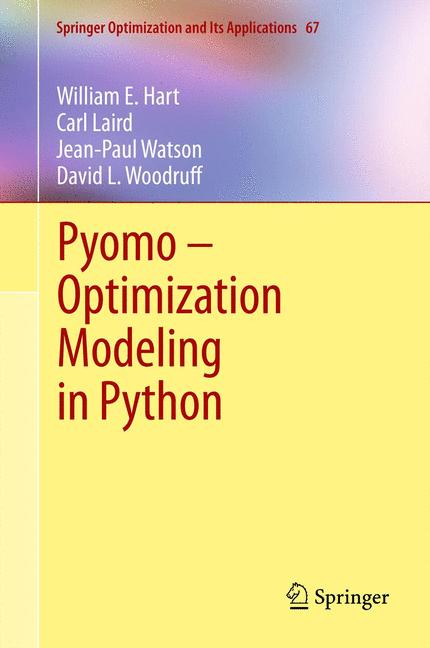
Pyomo – Optimization Modeling in Python
☆☆☆☆☆
(0 reviews)
Lowest price (incl. delivery)
56,50 EUR
Typical price54,43 PLN
Lowest (90 days)50,28 PLN
Offers2
Last updated3日前
| 販売者 | Product price | Delivery | 合計 | 在庫状況 | Updated | |
|---|---|---|---|---|---|---|
| SP SpringerNatureLink Shop INT | 56,50 EUR | free | 56,50 EUR | 在庫あり | 4日前 | View offer |
| SP Springer Nature Author | 56,50 EUR | free | 56,50 EUR | 在庫あり | 3日前 | View offer |
価格や在庫状況は変更される場合があります。 最終更新: 08.08.2026 20:41.
EAN
9781461432265
Springer Nature
0,0
☆☆☆☆☆
0 reviews
5★
0%
4★
0%
3★
0%
2★
0%
1★
0%
Product reviews
No reviews yet — be the first!
This book provides a complete and comprehensive reference/guide to Pyomo (Python Optimization Modeling Objects) for both beginning and advanced modelers, including students at the undergraduate and graduate levels, academic researchers, and practitioners. The text illustrates the breadth of the modeling and analysis capabilities that are supported by the software and support of complex real-world applications. Pyomo is an open source software package for formulating and solving large-scale optimization and operations research problems. The text begins with a tutorial on simple linear and integer programming models. A detailed reference of Pyomo's modeling components is illustrated with extensive examples, including a discussion of how to load data from data sources like spreadsheets and databases. Chapters describing advanced modeling capabilities for nonlinear and stochastic optimization are also included. The Pyomo software provides familiar modeling features within Python, a powerful dynamic programming language that has a very clear, readable syntax and intuitive object orientation. Pyomo includes Python classes for defining sparse sets, parameters, and variables, which can be used to formulate algebraic expressions that define objectives and constraints. Moreover, Pyomo can be used from a command-line interface and within Python's interactive command environment, which makes it easy to create Pyomo models, apply a variety of optimizers, and examine solutions. The software supports a different modeling approach than commercial AML (Algebraic Modeling Languages) tools, and is designed for flexibility, extensibility, portability, and maintainability but also maintains the central ideas in modern AMLs.
Similar products
 Patient Safety Coaching
from $91.97
Patient Safety Coaching
from $91.97
 Ethnography and Diversity
from $69.30
Ethnography and Diversity
from $69.30
 Smart Villages
from $91.97
Smart Villages
from $91.97
 Nuclear Non-Proliferation in International Law - Volume VI
from $91.97
Nuclear Non-Proliferation in International Law - Volume VI
from $91.97
 The Price of Freedom
from $91.97
The Price of Freedom
from $91.97
 Eco-Social Policy in the OECD and the World Bank
from $91.97
Eco-Social Policy in the OECD and the World Bank
from $91.97
 Special Topics in Policing
from $122.58
Special Topics in Policing
from $122.58
 Music from the Heart
from $91.97
Music from the Heart
from $91.97