
Personalizing Haptics
☆☆☆☆☆
(0 reviews)
Lowest price (incl. delivery)
18 608,00 JPY
Typical price1 279,97 PLN
Lowest (90 days)87,50 PLN
Offers6
Last updated1週間前
Price history (90 days)
Full history
2026-08-08
2026-08-15
| 更新日時 | 価格 |
|---|---|
| 2026-08-08 | 87,50 |
| 2026-08-15 | 87,50 |
| 販売者 | Product price | Delivery | 合計 | 在庫状況 | Updated | |
|---|---|---|---|---|---|---|
| SP SpringerNatureLink Shop INT | 18 589,00 JPY | 19,00 JPY | 18 608,00 JPY | 在庫あり | 5日前 | View offer |
| SP Springer Nature Author | 18 589,00 JPY | 25,00 JPY | 18 614,00 JPY | 在庫あり | 1週間前 | View offer |
| SP SpringerNatureLink Shop INT | 129,99 USD | 15,00 USD | 144,99 USD | 在庫あり | 5日前 | View offer |
| SP SpringerNatureLink Shop INT | 139,99 USD | 19,00 USD | 158,99 USD | 在庫あり | 5日前 | View offer |
| SP SpringerNatureLink Shop INT | 139,99 USD | 25,00 USD | 164,99 USD | 在庫あり | 5日前 | View offer |
| SP SpringerNatureLink Shop INT | 153,50 EUR | 25,00 EUR | 178,50 EUR | 在庫あり | 5日前 | View offer |
価格や在庫状況は変更される場合があります。 最終更新: 08.08.2026 22:23.
0,0
☆☆☆☆☆
0 reviews
5★
0%
4★
0%
3★
0%
2★
0%
1★
0%
Product reviews
No reviews yet — be the first!
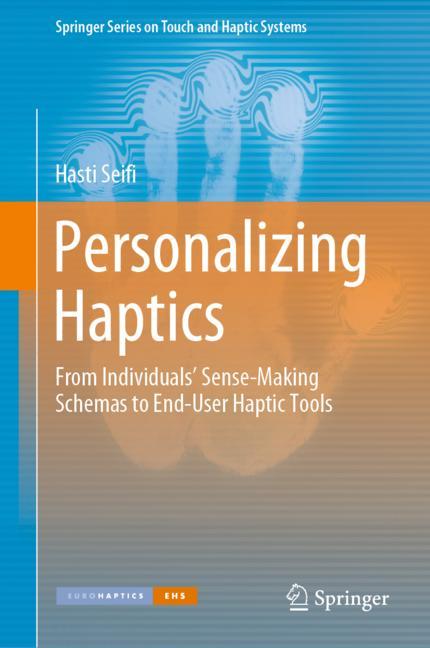
This monograph presents a vision for haptic personalization tools and lays the foundations for achieving it. Effective haptic personalization requires a suite of tools unified by one underlying conceptual model that can easily be incorporated into users’ workflows with various applications. Toward this vision, the book introduces three mechanisms for haptic personalization and details development of two of them into: 1) an efficient interface for choosing from a large haptic library, and 2) three emotion controls for adjusting haptic signals. A series of quantitative experiments identifies five schemas (engineering, sensation, emotion, metaphor, and usage examples) for how end-users think and talk about haptic sensations and characterizes them as the underlying model for the personalization tools. Personalizing Haptics highlights the need for scalable haptic evaluation methodologies and presents two methodologies for large-scale in-lab evaluation and online crowdsourcing of haptics. While the work focuses on vibrotactile signals as the most mature and accessible type of haptic feedback for end-users, the concepts and findings extend to other categories of haptics. Taking haptics to the crowds will require haptic design practices to go beyond the current one-size-fits-all approach to satisfy users’ diverse perceptual, functional, and hedonic needs reported in the literature. This book provides a starting point for students, researchers, and practitioners in academia or industry who aim to adapt their haptic and multisensory designs to the needs and preferences of a wide audience.
Similar products
 50 Years of Philosophy and Medicine
from $107.30
50 Years of Philosophy and Medicine
from $107.30
 Understanding Cybersecurity Law and Digital Privacy
from $122.63
Understanding Cybersecurity Law and Digital Privacy
from $122.63
 Decisions in International Trade and Logistics
from $122.63
Decisions in International Trade and Logistics
from $122.63
 Advances in Economic Measurement
from $122.63
Advances in Economic Measurement
from $122.63
 Nanomaterials
from $137.96
Nanomaterials
from $137.96
 Sustainable Scaffolds-based Strategies in Tissue Engineering and Regenerative Medicine
from $162.87
Sustainable Scaffolds-based Strategies in Tissue Engineering and Regenerative Medicine
from $162.87
 Narratives in Educational Research
from $162.87
Narratives in Educational Research
from $162.87
 Environmental Biology of the Young Chinese Sturgeon
from $210.78
Environmental Biology of the Young Chinese Sturgeon
from $210.78