
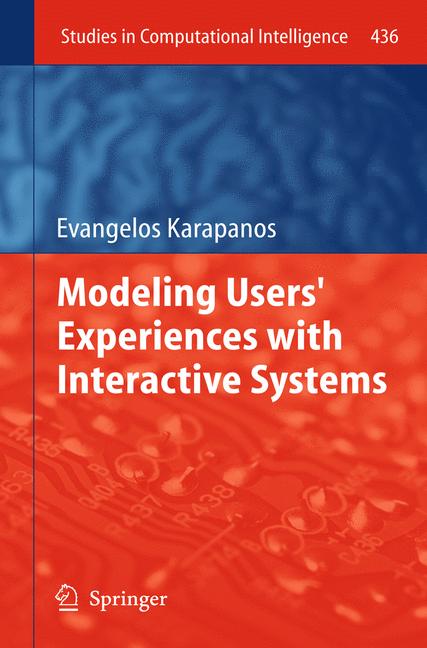
Modeling Users' Experiences with Interactive Systems
☆☆☆☆☆
(0 reviews)
Lowest price (incl. delivery)
14 318,00 JPY
Typical price1 131,13 PLN
Lowest (90 days)71,50 PLN
Offers6
Last updated1週間前
Price history (90 days)
Full history
2026-08-08
2026-08-15
| 更新日時 | 価格 |
|---|---|
| 2026-08-08 | 84,99 |
| 2026-08-15 | 71,50 |
| 販売者 | Product price | Delivery | 合計 | 在庫状況 | Updated | |
|---|---|---|---|---|---|---|
| SP SpringerNatureLink Shop INT | 14 299,00 JPY | 19,00 JPY | 14 318,00 JPY | 在庫あり | 5日前 | View offer |
| SP Springer Nature Author | 14 299,00 JPY | 29,00 JPY | 14 328,00 JPY | 在庫あり | 1週間前 | View offer |
| SP SpringerNatureLink Shop INT | 99,99 USD | 25,00 USD | 124,99 USD | 在庫あり | 6日前 | View offer |
| SP SpringerNatureLink Shop INT | 109,99 USD | free | 109,99 USD | 在庫あり | 6日前 | View offer |
| SP SpringerNatureLink Shop INT | 109,99 USD | free | 109,99 USD | 在庫あり | 6日前 | View offer |
| SP SpringerNatureLink Shop INT | 118,00 EUR | 29,00 EUR | 147,00 EUR | 在庫あり | 5日前 | View offer |
価格や在庫状況は変更される場合があります。 最終更新: 08.08.2026 23:21.
0,0
☆☆☆☆☆
0 reviews
5★
0%
4★
0%
3★
0%
2★
0%
1★
0%
Product reviews
No reviews yet — be the first!
Over the past decade the field of Human-Computer Interaction has evolved from the study of the usability of interactive products towards a more holistic understanding of how they may mediate desired human experiences. This book identifies the notion of diversity in usersʼ experiences with interactive products and proposes methods and tools for modeling this along two levels: (a) interpersonal diversity in usersʽ responses to early conceptual designs, and (b) the dynamics of usersʼ experiences over time. The Repertory Grid Technique is proposed as an alternative to standardized psychometric scales for modeling interpersonal diversity in usersʼ responses to early concepts in the design process, and new Multi-Dimensional Scaling procedures are introduced for modeling such complex quantitative data. iScale, a tool for the retrospective assessment of usersʼ experiences over time is proposed as an alternative to longitudinal field studies, and a semi-automated technique for the analysis of the elicited experience narratives is introduced. Through these two methodological contributions, this book argues against averaging in the subjective evaluation of interactive products. It proposes the development of interactive tools that can assist designers in moving across multiple levels of abstraction of empirical data, as design-relevant knowledge might be found on all these levels. Foreword by Jean-Bernard Martens and Closing Note by Marc Hassenzahl.
Similar products
 50 Years of Philosophy and Medicine
from $107.30
50 Years of Philosophy and Medicine
from $107.30
 Understanding Cybersecurity Law and Digital Privacy
from $122.63
Understanding Cybersecurity Law and Digital Privacy
from $122.63
 Decisions in International Trade and Logistics
from $122.63
Decisions in International Trade and Logistics
from $122.63
 Advances in Economic Measurement
from $122.63
Advances in Economic Measurement
from $122.63
 Nanomaterials
from $137.96
Nanomaterials
from $137.96
 Sustainable Scaffolds-based Strategies in Tissue Engineering and Regenerative Medicine
from $162.87
Sustainable Scaffolds-based Strategies in Tissue Engineering and Regenerative Medicine
from $162.87
 Narratives in Educational Research
from $162.87
Narratives in Educational Research
from $162.87
 Environmental Biology of the Young Chinese Sturgeon
from $210.78
Environmental Biology of the Young Chinese Sturgeon
from $210.78