
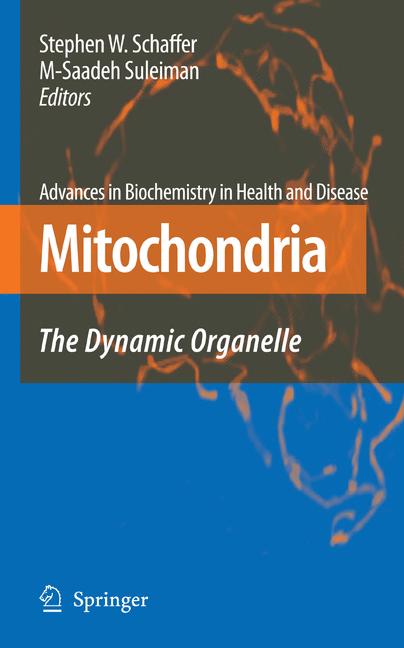
Mitochondria
☆☆☆☆☆
(0 reviews)
Lowest price (incl. delivery)
188,50 EUR
Typical price188,50 PLN
Lowest (90 days)188,50 PLN
Offers2
Last updated1週間前
Price history (90 days)
Full history
2026-08-08
2026-08-15
| 更新日時 | 価格 |
|---|---|
| 2026-08-08 | 188,50 |
| 2026-08-15 | 188,50 |
| 販売者 | Product price | Delivery | 合計 | 在庫状況 | Updated | |
|---|---|---|---|---|---|---|
| SP SpringerNatureLink Shop INT | 188,50 EUR | free | 188,50 EUR | 在庫あり | 6日前 | View offer |
| SP Springer Nature Author | 188,50 EUR | free | 188,50 EUR | 在庫あり | 1週間前 | View offer |
価格や在庫状況は変更される場合があります。 最終更新: 08.08.2026 22:45.
EAN
9780387699455
Springer Nature
0,0
☆☆☆☆☆
0 reviews
5★
0%
4★
0%
3★
0%
2★
0%
1★
0%
Product reviews
No reviews yet — be the first!
The term mitochondrion is derived from Latin, with mitos meaning thread and chondrion meaning granules. Indeed, under the light microscope, mitochondria often appear as rods or granules within the cytoplasm. For decades after initial visualization of mitochondria by light microscopy, mitochondrial function remained clouded. However, with the development of differential centri- gation and electron microscopy, it was discovered that a chief function of the mitochondria was the generation of ATP for the remainder of the cell. For many years, the energy generating function of the mitochondria was considered the primary, if not the sole function of the mitochondria. During that period, inves- gators attempted to obtain information on the mechanism of ATP synthesis and the regulation of electron transport. In the first chapter of the book, Dr. Hassinen summarizes those studies, providing clear pictures on the transformation of reducing equivalents into a proton gradient and the mechanism by which the F F 1 0 ATPase utilizes the proton gradient to generate ATP. He also summarizes the key regulatory steps of the citric acid cycle, which is the major source of reducing equivalents for the electron transport chain. In the heart, most of the carbon that feeds into the citric acid cycle is derived from fatty acid metabolism. Although fatty acid utilization provides most of the ATP for contraction, a proper balance must be maintained between the utilization of fatty acids and that of glucose. In the second chapter, Drs.
Similar products
 50 Years of Philosophy and Medicine
from $107.30
50 Years of Philosophy and Medicine
from $107.30
 Understanding Cybersecurity Law and Digital Privacy
from $122.63
Understanding Cybersecurity Law and Digital Privacy
from $122.63
 Decisions in International Trade and Logistics
from $122.63
Decisions in International Trade and Logistics
from $122.63
 Advances in Economic Measurement
from $122.63
Advances in Economic Measurement
from $122.63
 Nanomaterials
from $137.96
Nanomaterials
from $137.96
 Sustainable Scaffolds-based Strategies in Tissue Engineering and Regenerative Medicine
from $162.87
Sustainable Scaffolds-based Strategies in Tissue Engineering and Regenerative Medicine
from $162.87
 Narratives in Educational Research
from $162.87
Narratives in Educational Research
from $162.87
 Environmental Biology of the Young Chinese Sturgeon
from $210.78
Environmental Biology of the Young Chinese Sturgeon
from $210.78