
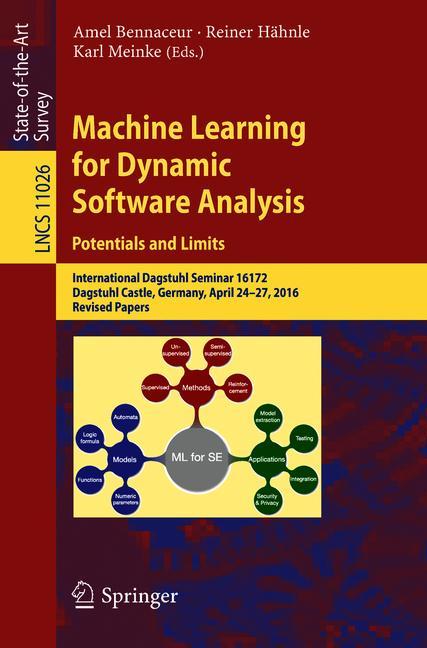
Machine Learning for Dynamic Software Analysis: Potentials and Limits
☆☆☆☆☆
(0 reviews)
Lowest price (incl. delivery)
77,14 USD
Typical price54,41 PLN
Lowest (90 days)39,99 PLN
Offers7
Last updated1週間前
Price history (90 days)
Full history
2026-08-08
2026-08-15
| 更新日時 | 価格 |
|---|---|
| 2026-08-08 | 48,14 |
| 2026-08-14 | 39,99 |
| 2026-08-15 | 64,99 |
| 販売者 | Product price | Delivery | 合計 | 在庫状況 | Updated | |
|---|---|---|---|---|---|---|
| SP SpringerNatureLink Shop INT | 48,14 USD | 29,00 USD | 77,14 USD | 在庫あり | 1日前 | View offer |
| SP SpringerNatureLink Shop INT | 48,14 USD | 19,00 USD | 67,14 USD | 在庫あり | 1日前 | View offer |
| SP SpringerNatureLink Shop INT | 48,14 USD | 25,00 USD | 73,14 USD | 在庫あり | 1日前 | View offer |
| SP SpringerNatureLink Shop INT | 49,99 GBP | free | 49,99 GBP | 在庫あり | 1日前 | View offer |
| SP SpringerNatureLink Shop INT | 64,99 USD | 15,00 USD | 79,99 USD | 在庫あり | 1日前 | View offer |
| SP SpringerNatureLink Shop INT | 64,99 USD | 19,00 USD | 83,99 USD | 在庫あり | 1日前 | View offer |
| SP Springer Nature Author | 64,99 USD | 25,00 USD | 89,99 USD | 在庫あり | 1週間前 | View offer |
価格や在庫状況は変更される場合があります。 最終更新: 08.08.2026 11:44.
0,0
☆☆☆☆☆
0 reviews
5★
0%
4★
0%
3★
0%
2★
0%
1★
0%
Product reviews
No reviews yet — be the first!
Machine learning of software artefacts is an emerging area of interaction between the machine learning and software analysis communities. Increased productivity in software engineering relies on the creation of new adaptive, scalable tools that can analyse large and continuously changing software systems. These require new software analysis techniques based on machine learning, such as learning-based software testing, invariant generation or code synthesis. Machine learning is a powerful paradigm that provides novel approaches to automating the generation of models and other essential software artifacts. This volume originates from a Dagstuhl Seminar entitled "Machine Learning for Dynamic Software Analysis: Potentials and Limits” held in April 2016. The seminar focused on fostering a spirit of collaboration in order to share insights and to expand and strengthen the cross-fertilisation between the machine learning and software analysis communities. The book provides an overview of the machine learning techniques that can be used for software analysis and presents example applications of their use. Besides an introductory chapter, the book is structured into three parts: testing and learning, extension of automata learning, and integrative approaches.
Similar products
 50 Years of Philosophy and Medicine
from $107.30
50 Years of Philosophy and Medicine
from $107.30
 Understanding Cybersecurity Law and Digital Privacy
from $122.63
Understanding Cybersecurity Law and Digital Privacy
from $122.63
 Decisions in International Trade and Logistics
from $122.63
Decisions in International Trade and Logistics
from $122.63
 Advances in Economic Measurement
from $122.63
Advances in Economic Measurement
from $122.63
 Nanomaterials
from $137.96
Nanomaterials
from $137.96
 Sustainable Scaffolds-based Strategies in Tissue Engineering and Regenerative Medicine
from $162.87
Sustainable Scaffolds-based Strategies in Tissue Engineering and Regenerative Medicine
from $162.87
 Narratives in Educational Research
from $162.87
Narratives in Educational Research
from $162.87
 Environmental Biology of the Young Chinese Sturgeon
from $210.78
Environmental Biology of the Young Chinese Sturgeon
from $210.78