
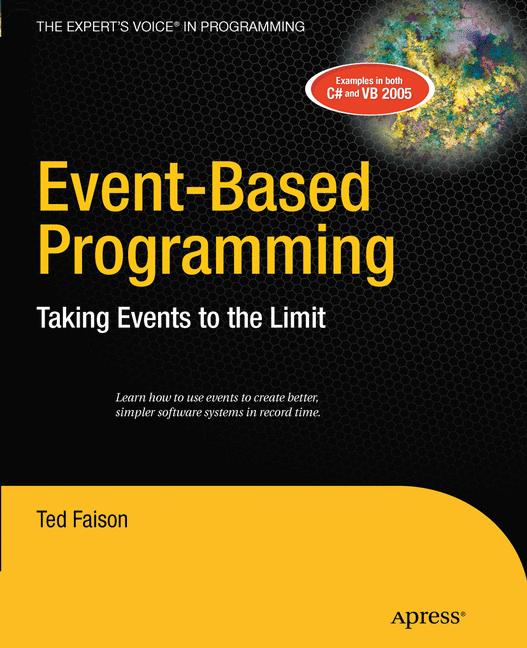
Event-Based Programming
☆☆☆☆☆
(0 reviews)
Lowest price (incl. delivery)
8 579,00 JPY
Typical price1 375,44 PLN
Lowest (90 days)62,39 PLN
Offers2
Last updated14時間前
| 販売者 | Product price | Delivery | 合計 | 在庫状況 | Updated | |
|---|---|---|---|---|---|---|
| SP Springer Nature Author | 8 579,00 JPY | free | 8 579,00 JPY | 在庫あり | 14時間前 | View offer |
| SP SpringerNatureLink Shop INT | 71,00 EUR | 19,00 EUR | 90,00 EUR | 在庫あり | 1日前 | View offer |
価格や在庫状況は変更される場合があります。 最終更新: 08.08.2026 23:17.
EAN
9781430243267
Springer Nature
0,0
☆☆☆☆☆
0 reviews
5★
0%
4★
0%
3★
0%
2★
0%
1★
0%
Product reviews
No reviews yet — be the first!
Now available in paperback— Languages like C#, VB .NET, and Delphi include built-in support for events, and these events become very powerful when they connect the objects and components of a system. Events make it possible for such parts to interact without any coupling. And the resulting parts can be developed and tested individually which keeps the code clean and simple. Component-based development (CBD) is an extension of object-oriented programming. CBD does away with the language and vendor-specific limitations of OOP, makes software reuse more practical and accelerates the development process. Event-based programming is the next logical step in CBD, and makes components more reusable due to their decoupled nature. But event-based systems are easier to develop, which means they're cheaper and more reliable than traditional OOP or CBD systems. This book teaches you how to develop software based on parts that interact primarily through an event mechanism. You'll learn howto use events in many different situations, to solve recurring development problems without coupling. The book introduces Signal Wiring Diagram, a novel form of software diagram similar to the circuit diagrams used by hardware designers. The book concludes with a series of case studies, incorporating all featured concepts. In a nutshell, you'll want to pick up a copy of this book because it: Shows how to use an event-based paradigm to reduce or completely eliminate coupling between classes and components Describes components, including coordinators, workers, builders, binders, and routers Contains three complete case studies that model concepts being used to design small, medium, and large systems
Similar products
 Patient Safety Coaching
from $91.97
Patient Safety Coaching
from $91.97
 Ethnography and Diversity
from $69.30
Ethnography and Diversity
from $69.30
 Smart Villages
from $91.97
Smart Villages
from $91.97
 Nuclear Non-Proliferation in International Law - Volume VI
from $91.97
Nuclear Non-Proliferation in International Law - Volume VI
from $91.97
 The Price of Freedom
from $91.97
The Price of Freedom
from $91.97
 Eco-Social Policy in the OECD and the World Bank
from $91.97
Eco-Social Policy in the OECD and the World Bank
from $91.97
 Special Topics in Policing
from $122.58
Special Topics in Policing
from $122.58
 Music from the Heart
from $91.97
Music from the Heart
from $91.97