
Enhancing Embedded Systems Simulation
☆☆☆☆☆
(0 reviews)
Lowest price (incl. delivery)
15 729,00 JPY
Typical price1 742,62 PLN
Lowest (90 days)99,99 PLN
Offers6
Last updated1週間前
Price history (90 days)
Full history
2026-08-08
2026-08-15
| 更新日時 | 価格 |
|---|---|
| 2026-08-08 | 109,99 |
| 2026-08-15 | 99,99 |
| 販売者 | Product price | Delivery | 合計 | 在庫状況 | Updated | |
|---|---|---|---|---|---|---|
| SP SpringerNatureLink Shop INT | 15 729,00 JPY | free | 15 729,00 JPY | 在庫あり | 3日前 | View offer |
| SP Springer Nature Author | 15 729,00 JPY | 29,00 JPY | 15 758,00 JPY | 在庫あり | 1週間前 | View offer |
| SP SpringerNatureLink Shop INT | 109,99 USD | free | 109,99 USD | 在庫あり | 3日前 | View offer |
| SP SpringerNatureLink Shop INT | 119,99 USD | 15,00 USD | 134,99 USD | 在庫あり | 3日前 | View offer |
| SP SpringerNatureLink Shop INT | 119,99 USD | 25,00 USD | 144,99 USD | 在庫あり | 3日前 | View offer |
| SP SpringerNatureLink Shop INT | 130,00 EUR | free | 130,00 EUR | 在庫あり | 3日前 | View offer |
価格や在庫状況は変更される場合があります。 最終更新: 08.08.2026 23:26.
0,0
☆☆☆☆☆
0 reviews
5★
0%
4★
0%
3★
0%
2★
0%
1★
0%
Product reviews
No reviews yet — be the first!
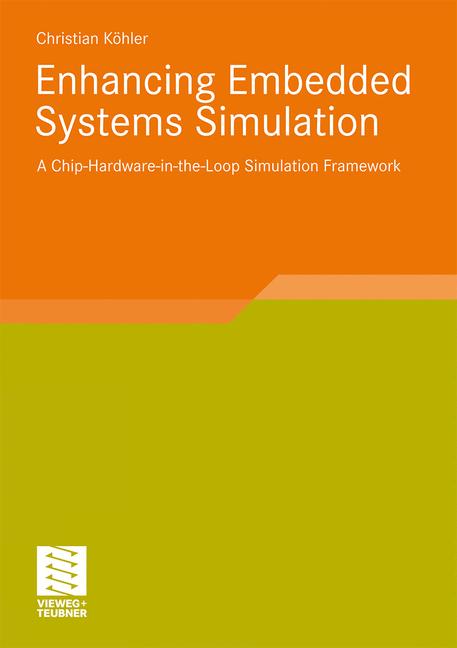
Using the real Microcontroller (µC) as a replacement for a µC model inside a system simulation of a µC-based system is a big benefit since the µC is already verified. Moreover, its maximum performance and its accuracy are much higher than any simulation model. With the Chip-Hardware-in-the-Loop Simulation (CHILS) approach, Christian Köhler covers the connection between µC and simulation, the analysis and optimization of such coupling systems as well as the interface abstraction. He develops the hardware to simulation coupling system with a focus on less hardware effort, the capabilities to couple with different simulation environments, and the efficiency of coupling. The interface abstraction primarily supports the efficiency of coupling. The system analysis and optimization concepts include formal criteria to determine the fidelity of Hardware-in-the-Loop (HIL) coupling systems, stability analysis of coupling systems, and the numerical analysis of applied software algorithms. Furthermore, the author presents existing concepts to simulate complex systems and compares them with the new approach.
Similar products
 50 Years of Philosophy and Medicine
from $107.30
50 Years of Philosophy and Medicine
from $107.30
 Understanding Cybersecurity Law and Digital Privacy
from $122.63
Understanding Cybersecurity Law and Digital Privacy
from $122.63
 Decisions in International Trade and Logistics
from $122.63
Decisions in International Trade and Logistics
from $122.63
 Advances in Economic Measurement
from $122.63
Advances in Economic Measurement
from $122.63
 Nanomaterials
from $137.96
Nanomaterials
from $137.96
 Sustainable Scaffolds-based Strategies in Tissue Engineering and Regenerative Medicine
from $162.87
Sustainable Scaffolds-based Strategies in Tissue Engineering and Regenerative Medicine
from $162.87
 Narratives in Educational Research
from $162.87
Narratives in Educational Research
from $162.87
 Environmental Biology of the Young Chinese Sturgeon
from $210.78
Environmental Biology of the Young Chinese Sturgeon
from $210.78