
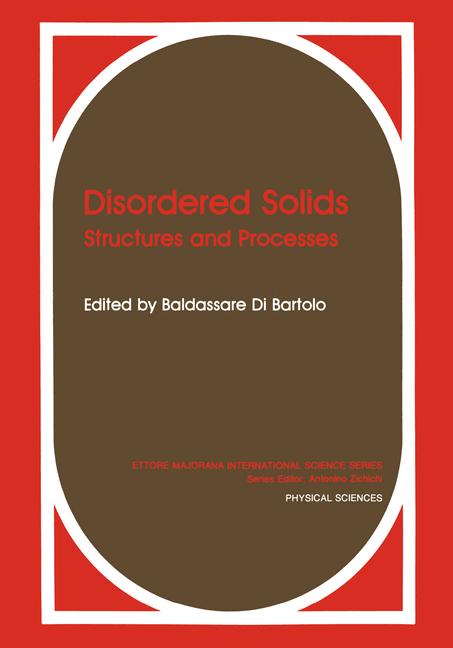
Disordered Solids
☆☆☆☆☆
(0 reviews)
Lowest price (incl. delivery)
7 164,00 JPY
Typical price362,20 PLN
Lowest (90 days)49,99 PLN
Offers2
Last updated12時間前
| 販売者 | Product price | Delivery | 合計 | 在庫状況 | Updated | |
|---|---|---|---|---|---|---|
| SP Springer Nature Author | 7 149,00 JPY | 15,00 JPY | 7 164,00 JPY | 在庫あり | 12時間前 | View offer |
| SP SpringerNatureLink Shop INT | 59,00 EUR | 29,00 EUR | 88,00 EUR | 在庫あり | 1日前 | View offer |
価格や在庫状況は変更される場合があります。 最終更新: 08.08.2026 23:12.
0,0
☆☆☆☆☆
0 reviews
5★
0%
4★
0%
3★
0%
2★
0%
1★
0%
Product reviews
No reviews yet — be the first!
This book presents an account of the course "Disordered Solids: Structures and Processes" held in Erice, Italy, from June 15 to 29, 1987. This meeting was organized by the International School of Atomic and Molecular Spectroscopy of the "Ettore Majorana" Centre for Scientific Culture. The objective of this course was to present the advances in physical modelling, mathematical formalism and experimental techniques relevant to the interpretation of the structures of disordered solids and of the physical processes occurring therein. Traditional solid-state physics treats solids as perfect crystals and takes great advantage of their symmetry, by means of such mathematical formalisms as the reciprocal lattice, the Brillouin zone, and the powerful tools of group theory. Even if in reality no solid is a perfect crystal, this theoretical approach has been of great usefulness in describing solids: deviations from perfect order have been treated as perturbations of the ideal model. A new situation arises with truly disordered solids where any vestige of long range order has disappeared. The basic problem is that of describing these systems and gaining a scientific understanding of their physical properties without the mathematical formalism of traditional solid state physics. While some of the old approaches may occasionally remain valid (e. g. chemical bonding approach for amorphous solids), the old ways will not do. Disorder is not a perturbation: with disorder, something basically new may be expected to appear.
Similar products
 Patient Safety Coaching
from $91.97
Patient Safety Coaching
from $91.97
 Ethnography and Diversity
from $69.30
Ethnography and Diversity
from $69.30
 Smart Villages
from $91.97
Smart Villages
from $91.97
 Nuclear Non-Proliferation in International Law - Volume VI
from $91.97
Nuclear Non-Proliferation in International Law - Volume VI
from $91.97
 The Price of Freedom
from $91.97
The Price of Freedom
from $91.97
 Eco-Social Policy in the OECD and the World Bank
from $91.97
Eco-Social Policy in the OECD and the World Bank
from $91.97
 Special Topics in Policing
from $122.58
Special Topics in Policing
from $122.58
 Music from the Heart
from $91.97
Music from the Heart
from $91.97