
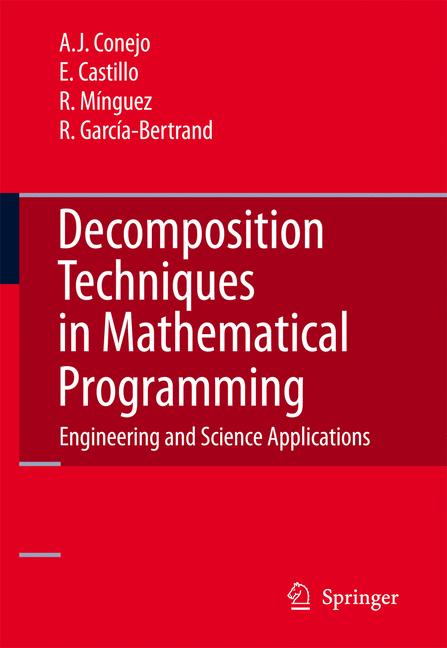
Decomposition Techniques in Mathematical Programming
☆☆☆☆☆
(0 reviews)
| 販売者 | Product price | Delivery | 合計 | 在庫状況 | Updated | |
|---|---|---|---|---|---|---|
| SP SpringerNatureLink Shop INT | 299,99 USD | free | 299,99 USD | 在庫あり | 8時間前 | View offer |
| SP SpringerNatureLink Shop INT | 299,99 USD | free | 299,99 USD | 在庫あり | 8時間前 | View offer |
| SP SpringerNatureLink Shop INT | 329,99 EUR | 25,00 EUR | 354,99 EUR | 在庫あり | 8時間前 | View offer |
価格や在庫状況は変更される場合があります。 最終更新: 15.08.2026 07:34.
0,0
☆☆☆☆☆
0 reviews
5★
0%
4★
0%
3★
0%
2★
0%
1★
0%
Product reviews
No reviews yet — be the first!
Optimization plainly dominates the design, planning, operation, and c- trol of engineering systems. This is a book on optimization that considers particular cases of optimization problems, those with a decomposable str- ture that can be advantageously exploited. Those decomposable optimization problems are ubiquitous in engineering and science applications. The book considers problems with both complicating constraints and complicating va- ables, and analyzes linear and nonlinear problems, with and without in- ger variables. The decomposition techniques analyzed include Dantzig-Wolfe, Benders, Lagrangian relaxation, Augmented Lagrangian decomposition, and others. Heuristic techniques are also considered. Additionally, a comprehensive sensitivity analysis for characterizing the solution of optimization problems is carried out. This material is particularly novel and of high practical interest. This book is built based on many clarifying, illustrative, and compu- tional examples, which facilitate the learning procedure. For the sake of cl- ity, theoretical concepts and computational algorithms are assembled based on these examples. The results are simplicity, clarity, and easy-learning. We feel that this book is needed by the engineering community that has to tackle complex optimization problems, particularly by practitioners and researchersinEngineering,OperationsResearch,andAppliedEconomics.The descriptions of most decomposition techniques are available only in complex and specialized mathematical journals, di?cult to understand by engineers. A book describing a wide range of decomposition techniques, emphasizing problem-solving, and appropriately blending theory and application, was not previously available.
Similar products
 50 Years of Philosophy and Medicine
from $107.30
50 Years of Philosophy and Medicine
from $107.30
 Understanding Cybersecurity Law and Digital Privacy
from $122.63
Understanding Cybersecurity Law and Digital Privacy
from $122.63
 Decisions in International Trade and Logistics
from $122.63
Decisions in International Trade and Logistics
from $122.63
 Advances in Economic Measurement
from $122.63
Advances in Economic Measurement
from $122.63
 Nanomaterials
from $137.96
Nanomaterials
from $137.96
 Sustainable Scaffolds-based Strategies in Tissue Engineering and Regenerative Medicine
from $162.87
Sustainable Scaffolds-based Strategies in Tissue Engineering and Regenerative Medicine
from $162.87
 Narratives in Educational Research
from $162.87
Narratives in Educational Research
from $162.87
 Environmental Biology of the Young Chinese Sturgeon
from $210.78
Environmental Biology of the Young Chinese Sturgeon
from $210.78