
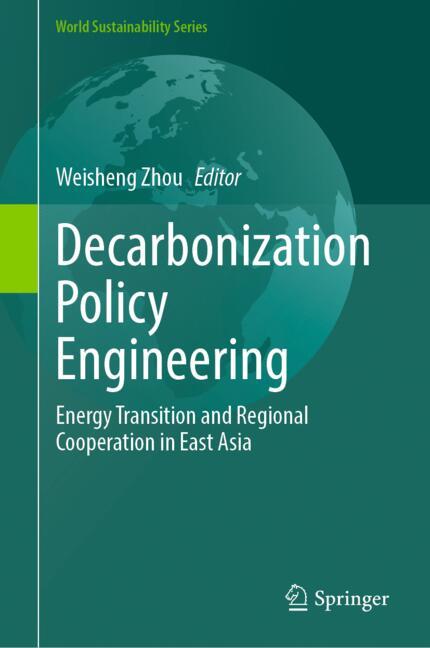
Decarbonization Policy Engineering
☆☆☆☆☆
(0 reviews)
Lowest price (incl. delivery)
24 309,00 JPY
Typical price1 064,27 PLN
Lowest (90 days)59,70 PLN
Offers4
Last updated1週間前
Price history (90 days)
Full history
2026-08-08
2026-08-15
| 更新日時 | 価格 |
|---|---|
| 2026-08-08 | 59,70 |
| 2026-08-15 | 201,00 |
| 販売者 | Product price | Delivery | 合計 | 在庫状況 | Updated | |
|---|---|---|---|---|---|---|
| SP SpringerNatureLink Shop INT | 24 309,00 JPY | free | 24 309,00 JPY | 在庫あり | 13時間前 | View offer |
| SP Springer Nature Author | 24 309,00 JPY | 29,00 JPY | 24 338,00 JPY | 在庫あり | 6日前 | View offer |
| SP SpringerNatureLink Shop INT | 201,00 EUR | 25,00 EUR | 226,00 EUR | 在庫あり | 15時間前 | View offer |
| VI VitalSource | 1 132,80 ZAR | free | 1 132,80 ZAR | 在庫あり | 1週間前 | View offer |
価格や在庫状況は変更される場合があります。 最終更新: 08.08.2026 06:36.
EAN
9789819559527
Springer Nature
0,0
☆☆☆☆☆
0 reviews
5★
0%
4★
0%
3★
0%
2★
0%
1★
0%
Product reviews
No reviews yet — be the first!
Climate change represents one of humanity’s most profound and uncertain challenges—demanding innovation, cooperation, and systemic transformation. Decarbonization Policy Engineering: Energy Transition and Regional Cooperation in East Asia provides a comprehensive, interdisciplinary framework for navigating this transition. Structured around three core themes: 1. Strategies and Prospects for Carbon Neutrality in East Asia: This section analyzes decarbonization pathways, policy frameworks, and challenges specific to China, Japan, and South Korea. It explores national strategies, energy security, climate policy philosophy, and the potential for regional cooperation, including a joint carbon market. 2. System Evaluation of the Optimal Energy Mix: The focus here is on the technical and engineering aspects of the energy transition. Research includes optimizing integrated energy system design, conducting scenario analyses for future pathways, and evaluating the impacts of climate change on energy consumption. 3. Innovations for a Decarbonized Society: This segment broadens the scope to cross-cutting enablers of decarbonization. It covers climate finance, carbon accounting, technological breakthroughs, consumer behavior, carbon border mechanisms, life cycle assessment, and sector-specific strategies for waste management and residential energy use. By treating uncertainty not as a barrier but as a catalyst for innovation, this book redefines the future of energy policy. It serves as an essential compass for policymakers, researchers, and practitioners striving to engineer a sustainable, carbon-neutral future for East Asia—and beyond.
Similar products
 50 Years of Philosophy and Medicine
from $107.30
50 Years of Philosophy and Medicine
from $107.30
 Understanding Cybersecurity Law and Digital Privacy
from $122.63
Understanding Cybersecurity Law and Digital Privacy
from $122.63
 Decisions in International Trade and Logistics
from $122.63
Decisions in International Trade and Logistics
from $122.63
 Advances in Economic Measurement
from $122.63
Advances in Economic Measurement
from $122.63
 Nanomaterials
from $137.96
Nanomaterials
from $137.96
 Sustainable Scaffolds-based Strategies in Tissue Engineering and Regenerative Medicine
from $162.87
Sustainable Scaffolds-based Strategies in Tissue Engineering and Regenerative Medicine
from $162.87
 Narratives in Educational Research
from $162.87
Narratives in Educational Research
from $162.87
 Environmental Biology of the Young Chinese Sturgeon
from $210.78
Environmental Biology of the Young Chinese Sturgeon
from $210.78