
Context-Aware Ranking with Factorization Models
☆☆☆☆☆
(0 reviews)
Lowest price (incl. delivery)
14 328,00 JPY
Typical price1 131,13 PLN
Lowest (90 days)71,50 PLN
Offers6
Last updated1週間前
Price history (90 days)
Full history
2026-08-08
2026-08-15
| 更新日時 | 価格 |
|---|---|
| 2026-08-08 | 84,99 |
| 2026-08-15 | 71,50 |
| 販売者 | Product price | Delivery | 合計 | 在庫状況 | Updated | |
|---|---|---|---|---|---|---|
| SP SpringerNatureLink Shop INT | 14 299,00 JPY | 29,00 JPY | 14 328,00 JPY | 在庫あり | 6日前 | View offer |
| SP Springer Nature Author | 14 299,00 JPY | 19,00 JPY | 14 318,00 JPY | 在庫あり | 1週間前 | View offer |
| SP SpringerNatureLink Shop INT | 99,99 USD | 15,00 USD | 114,99 USD | 在庫あり | 6日前 | View offer |
| SP SpringerNatureLink Shop INT | 109,99 USD | 15,00 USD | 124,99 USD | 在庫あり | 6日前 | View offer |
| SP SpringerNatureLink Shop INT | 109,99 USD | 15,00 USD | 124,99 USD | 在庫あり | 6日前 | View offer |
| SP SpringerNatureLink Shop INT | 118,00 EUR | 15,00 EUR | 133,00 EUR | 在庫あり | 6日前 | View offer |
価格や在庫状況は変更される場合があります。 最終更新: 08.08.2026 23:21.
0,0
☆☆☆☆☆
0 reviews
5★
0%
4★
0%
3★
0%
2★
0%
1★
0%
Product reviews
No reviews yet — be the first!
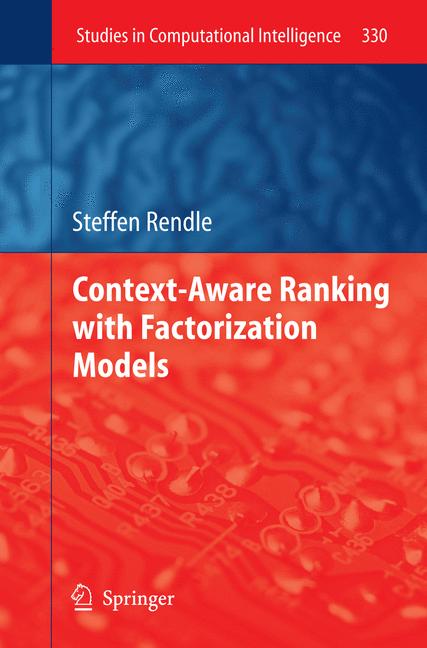
Context-aware ranking is an important task with many applications. E.g. in recommender systems items (products, movies, ...) and for search engines webpages should be ranked. In all these applications, the ranking is not global (i.e. always the same) but depends on the context. Simple examples for context are the user for recommender systems and the query for search engines. More complicated context includes time, last actions, etc. The major problem is that typically the variable domains (e.g. customers, products) are categorical and huge, the observations are very sparse and only positive events are observed. In this book, a generic method for context-aware ranking as well as its application are presented. For modelling a new factorization based on pairwise interactions is proposed and compared to other tensor factorization approaches. For learning, the `Bayesian Context-aware Ranking' framework consisting of an optimization criterion and algorithm is developed. The second main part of the book applies this general theory to the three scenarios of item, tag and sequential-set recommendation. Furthermore extensions of time-variant factors and one-class problems are studied. This book generalizes and builds on work that has received the `WWW 2010 Best Paper Award', the `WSDM 2010 Best Student Paper Award' and the `ECML/PKDD 2009 Best Discovery Challenge Award'.
Similar products
 50 Years of Philosophy and Medicine
from $107.30
50 Years of Philosophy and Medicine
from $107.30
 Understanding Cybersecurity Law and Digital Privacy
from $122.63
Understanding Cybersecurity Law and Digital Privacy
from $122.63
 Decisions in International Trade and Logistics
from $122.63
Decisions in International Trade and Logistics
from $122.63
 Advances in Economic Measurement
from $122.63
Advances in Economic Measurement
from $122.63
 Nanomaterials
from $137.96
Nanomaterials
from $137.96
 Sustainable Scaffolds-based Strategies in Tissue Engineering and Regenerative Medicine
from $162.87
Sustainable Scaffolds-based Strategies in Tissue Engineering and Regenerative Medicine
from $162.87
 Narratives in Educational Research
from $162.87
Narratives in Educational Research
from $162.87
 Environmental Biology of the Young Chinese Sturgeon
from $210.78
Environmental Biology of the Young Chinese Sturgeon
from $210.78