
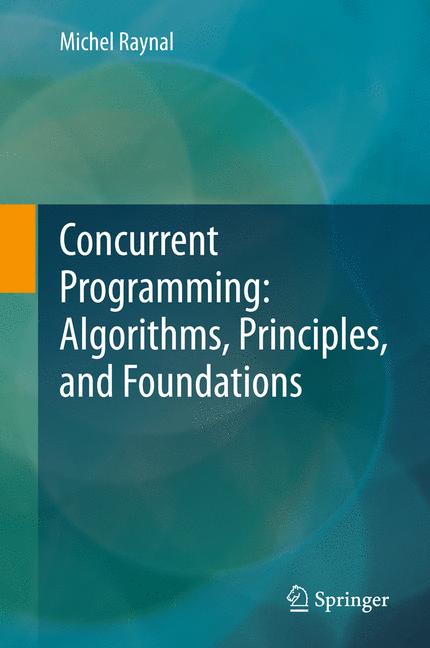
Concurrent Programming: Algorithms, Principles, and Foundations
☆☆☆☆☆
(0 reviews)
Lowest price (incl. delivery)
148,00 USD
Typical price90,67 PLN
Lowest (90 days)20,10 PLN
Offers3
Last updated4日前
Price history (90 days)
Full history
2026-08-07
2026-08-08
| 更新日時 | 価格 |
|---|---|
| 2026-08-07 | 20,10 |
| 2026-08-08 | 37,15 |
| 販売者 | Product price | Delivery | 合計 | 在庫状況 | Updated | |
|---|---|---|---|---|---|---|
| SP Springer Nature Author | 119,00 USD | 29,00 USD | 148,00 USD | 在庫あり | 4日前 | View offer |
| SP SpringerNatureLink Shop INT | 96,50 GBP | 25,00 GBP | 121,50 GBP | 在庫あり | 4日前 | View offer |
| VI VitalSource | 506,62 ZAR | free | 506,62 ZAR | 在庫あり | 4日前 | View offer |
価格や在庫状況は変更される場合があります。 最終更新: 08.08.2026 06:09.
EAN
9783642320262
Springer Nature
0,0
☆☆☆☆☆
0 reviews
5★
0%
4★
0%
3★
0%
2★
0%
1★
0%
Product reviews
No reviews yet — be the first!
This book is devoted to the most difficult part of concurrent programming, namely synchronization concepts, techniques and principles when the cooperating entities are asynchronous, communicate through a shared memory, and may experience failures. Synchronization is no longer a set of tricks but, due to research results in recent decades, it relies today on sane scientific foundations as explained in this book. In this book the author explains synchronization and the implementation of concurrent objects, presenting in a uniform and comprehensive way the major theoretical and practical results of the past 30 years. Among the key features of the book are a new look at lock-based synchronization (mutual exclusion, semaphores, monitors, path expressions); an introduction to the atomicity consistency criterion and its properties and a specific chapter on transactional memory; an introduction to mutex-freedom and associated progress conditions such as obstruction-freedom and wait-freedom; a presentation of Lamport's hierarchy of safe, regular and atomic registers and associated wait-free constructions; a description of numerous wait-free constructions of concurrent objects (queues, stacks, weak counters, snapshot objects, renaming objects, etc.); a presentation of the computability power of concurrent objects including the notions of universal construction, consensus number and the associated Herlihy's hierarchy; and a survey of failure detector-based constructions of consensus objects. The book is suitable for advanced undergraduate students and graduate students in computer science or computer engineering, graduate students in mathematics interested in the foundations of process synchronization, and practitioners and engineers who need to produce correct concurrent software. The reader should have a basic knowledge of algorithms and operating systems.
Similar products
 Patient Safety Coaching
from $91.97
Patient Safety Coaching
from $91.97
 Ethnography and Diversity
from $69.30
Ethnography and Diversity
from $69.30
 Smart Villages
from $91.97
Smart Villages
from $91.97
 Nuclear Non-Proliferation in International Law - Volume VI
from $91.97
Nuclear Non-Proliferation in International Law - Volume VI
from $91.97
 The Price of Freedom
from $91.97
The Price of Freedom
from $91.97
 Eco-Social Policy in the OECD and the World Bank
from $91.97
Eco-Social Policy in the OECD and the World Bank
from $91.97
 Special Topics in Policing
from $122.58
Special Topics in Policing
from $122.58
 Music from the Heart
from $91.97
Music from the Heart
from $91.97