
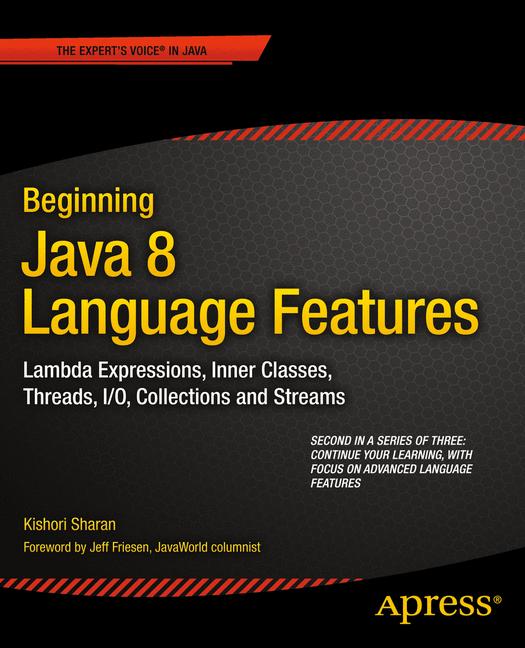
Beginning Java 8 Language Features
☆☆☆☆☆
(0 reviews)
Lowest price (incl. delivery)
5 748,00 JPY
Typical price287,51 PLN
Lowest (90 days)39,99 PLN
Offers2
Last updated15時間前
| 販売者 | Product price | Delivery | 合計 | 在庫状況 | Updated | |
|---|---|---|---|---|---|---|
| SP Springer Nature Author | 5 719,00 JPY | 29,00 JPY | 5 748,00 JPY | 在庫あり | 15時間前 | View offer |
| SP SpringerNatureLink Shop INT | 47,00 EUR | 29,00 EUR | 76,00 EUR | 在庫あり | 1日前 | View offer |
価格や在庫状況は変更される場合があります。 最終更新: 08.08.2026 23:08.
0,0
☆☆☆☆☆
0 reviews
5★
0%
4★
0%
3★
0%
2★
0%
1★
0%
Product reviews
No reviews yet — be the first!
Beginning Java 8 Language Features covers essential and advanced features of the Java programming language such as the new lambda expressions (closures), inner classes, threads, I/O, Collections, garbage collection, streams, and more. Author Kishori Sharan provides over 60 diagrams and 290 complete programs to help you visualize and better understand the topics covered in this book. The book starts with a series of chapters on the essential language features provided by Java, including annotations, inner classes, reflection, and generics. These topics are then complemented by details of how to use lambda expressions, allowing you to build powerful and efficient Java programs. The chapter on threads follows this up and discusses everything from the very basic concepts of a thread to the most advanced topics such as synchronizers, the fork/join framework, and atomic variables. This book contains unmatched coverage of Java I/O, including NIO 2.0, the Path API, the FileVisitor API, the watch service and asynchronous file I/O. With this in-depth knowledge, your data- and file-management programs will be able to take advantage of every feature of Java's powerful I/O framework. Finally, you'll learn how to use the Stream API, a new, exciting addition to Java 8, to perform aggregate operations on collections of data elements using functional-style programming. You'll examine the details of stream processing such as creating streams from different data sources, learning the difference between sequential and parallel streams, applying the filter-map-reduce pattern, and dealing with optional values.
Similar products
 Patient Safety Coaching
from $91.97
Patient Safety Coaching
from $91.97
 Ethnography and Diversity
from $69.30
Ethnography and Diversity
from $69.30
 Smart Villages
from $91.97
Smart Villages
from $91.97
 Nuclear Non-Proliferation in International Law - Volume VI
from $91.97
Nuclear Non-Proliferation in International Law - Volume VI
from $91.97
 The Price of Freedom
from $91.97
The Price of Freedom
from $91.97
 Eco-Social Policy in the OECD and the World Bank
from $91.97
Eco-Social Policy in the OECD and the World Bank
from $91.97
 Special Topics in Policing
from $122.58
Special Topics in Policing
from $122.58
 Music from the Heart
from $91.97
Music from the Heart
from $91.97