
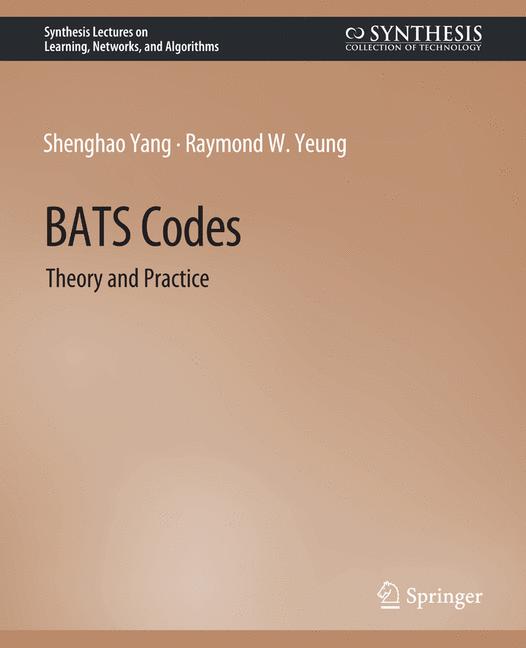
BATS Codes
☆☆☆☆☆
(0 reviews)
Lowest price (incl. delivery)
7 168,00 JPY
Typical price314,07 PLN
Lowest (90 days)39,99 PLN
Offers2
Last updated21時間前
| 販売者 | Product price | Delivery | 合計 | 在庫状況 | Updated | |
|---|---|---|---|---|---|---|
| SP Springer Nature Author | 7 149,00 JPY | 19,00 JPY | 7 168,00 JPY | 在庫あり | 21時間前 | View offer |
| SP SpringerNatureLink Shop INT | 59,00 EUR | 19,00 EUR | 78,00 EUR | 在庫あり | 1日前 | View offer |
価格や在庫状況は変更される場合があります。 最終更新: 08.08.2026 23:08.
0,0
☆☆☆☆☆
0 reviews
5★
0%
4★
0%
3★
0%
2★
0%
1★
0%
Product reviews
No reviews yet — be the first!
This book discusses an efficient random linear network coding scheme, called BATched Sparse code, or BATS code, which is proposed for communication through multi-hop networks with packet loss. Multi-hop wireless networks have applications in the Internet of Things (IoT), space, and under-water network communications, where the packet loss rate per network link is high, and feedbacks have long delays and are unreliable. Traditional schemes like retransmission and fountain codes are not sufficient to resolve the packet loss so that the existing communication solutions for multi-hop wireless networks have either long delay or low throughput when the network length is longer than a few hops. These issues can be resolved by employing network coding in the network, but the high computational and storage costs of such schemes prohibit their implementation in many devices, in particular, IoT devices that typically have low computational power and very limited storage. A BATS code consists of an outer code and an inner code. As a matrix generalization of a fountain code, the outer code generates a potentially unlimited number of batches, each of which consists of a certain number (called the batch size) of coded packets. The inner code comprises (random) linear network coding at the intermediate network nodes, which is applied on packets belonging to the same batch. When the batch size is 1, the outer code reduces to an LT code (or Raptor code if precode is applied), and network coding of the batches reduces to packet forwarding. BATS codes preserve the salient features of fountain codes, in particular, their rateless property and low encoding/decoding complexity. BATS codes also achieve the throughput gain of random linear network coding. This book focuses on the fundamental features and performance analysis of BATS codes, and includes some guidelines and examples on how to design a network protocol using BATS codes.
Similar products
 Patient Safety Coaching
from $91.97
Patient Safety Coaching
from $91.97
 Ethnography and Diversity
from $69.30
Ethnography and Diversity
from $69.30
 Smart Villages
from $91.97
Smart Villages
from $91.97
 Nuclear Non-Proliferation in International Law - Volume VI
from $91.97
Nuclear Non-Proliferation in International Law - Volume VI
from $91.97
 The Price of Freedom
from $91.97
The Price of Freedom
from $91.97
 Eco-Social Policy in the OECD and the World Bank
from $91.97
Eco-Social Policy in the OECD and the World Bank
from $91.97
 Special Topics in Policing
from $122.58
Special Topics in Policing
from $122.58
 Music from the Heart
from $91.97
Music from the Heart
from $91.97