
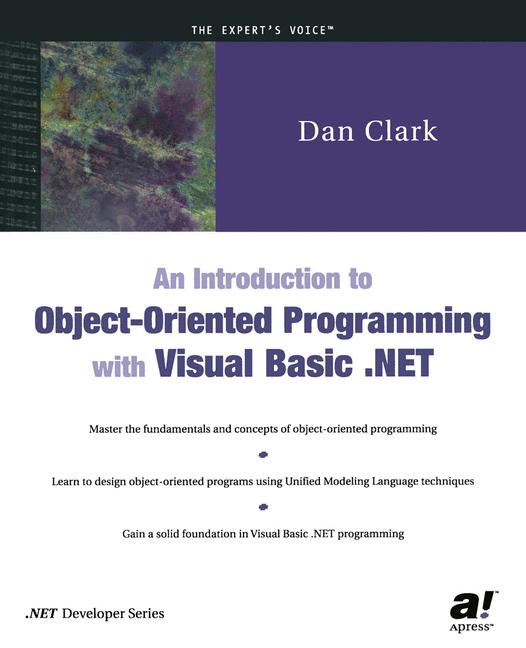
An Introduction to Object-Oriented Programming with Visual Basic .NET
☆☆☆☆☆
(0 reviews)
Lowest price (incl. delivery)
48,99 USD
Typical price29,99 PLN
Lowest (90 days)29,99 PLN
Offers2
Last updated1日前
| 販売者 | Product price | Delivery | 合計 | 在庫状況 | Updated | |
|---|---|---|---|---|---|---|
| SP SpringerNatureLink Shop INT | 29,99 USD | 19,00 USD | 48,99 USD | 在庫あり | 1日前 | View offer |
| SP Springer Nature Author | 29,99 USD | 15,00 USD | 44,99 USD | 在庫あり | 17時間前 | View offer |
価格や在庫状況は変更される場合があります。 最終更新: 08.08.2026 07:39.
0,0
☆☆☆☆☆
0 reviews
5★
0%
4★
0%
3★
0%
2★
0%
1★
0%
Product reviews
No reviews yet — be the first!
As you work your way through An Introduction to Object-Oriented Programming with Visual Basic .NET, you'll learn how to analyze the business requirements of an application, model the objects and relationships involved in the solution design and, finally, implement the solution using Visual Basic .NET. Along the way you'll also learn the fundamentals of software design, the Unified Modeling Language (UML), object-oriented programming, and Visual Basic .NET. An Introduction to Object-Oriented Programming with Visual Basic .NET is logically organized into three parts. Part One delves into object-oriented programming methodology and design, concepts that transcend a particular programming language. The concepts presented are important to the success of an object-oriented programming solution regardless of the implementation language chosen. At the conclusion of this part, a case study walks you through the design of a solution based on a real-world scenario. Part Two looks at how object-oriented programming is implemented in Visual Basic .NET. You will explore the structure of classes, class hierarchies, inheritance, and interfaces. The .NET Framework is introduced along with the Visual Studio integrated development environment (IDE). Part Three returns to the case study introduced at the end of Part One. Using the knowledge gained in Part Two, programmers will transform the design into a functional VB .NET application. The application includes a graphical user interface, a business logic class library, and integration with a back-end database.
Similar products
 Patient Safety Coaching
from $91.97
Patient Safety Coaching
from $91.97
 Ethnography and Diversity
from $69.30
Ethnography and Diversity
from $69.30
 Smart Villages
from $91.97
Smart Villages
from $91.97
 Nuclear Non-Proliferation in International Law - Volume VI
from $91.97
Nuclear Non-Proliferation in International Law - Volume VI
from $91.97
 The Price of Freedom
from $91.97
The Price of Freedom
from $91.97
 Eco-Social Policy in the OECD and the World Bank
from $91.97
Eco-Social Policy in the OECD and the World Bank
from $91.97
 Special Topics in Policing
from $122.58
Special Topics in Policing
from $122.58
 Music from the Heart
from $91.97
Music from the Heart
from $91.97