
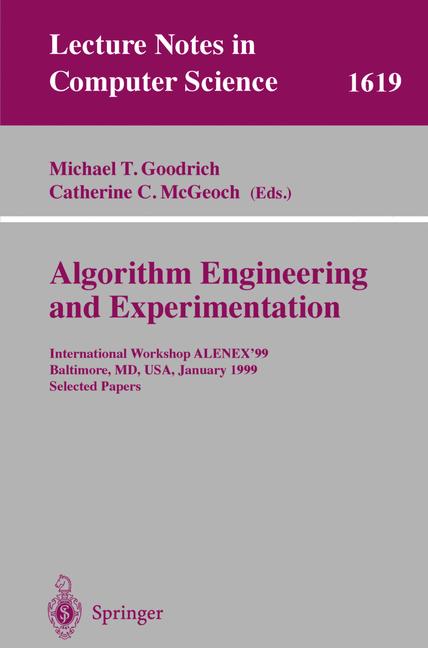
Algorithm Engineering and Experimentation
☆☆☆☆☆
(0 reviews)
Lowest price (incl. delivery)
7 149,00 JPY
Typical price321,86 PLN
Lowest (90 days)39,99 PLN
Offers2
Last updated12時間前
| 販売者 | Product price | Delivery | 合計 | 在庫状況 | Updated | |
|---|---|---|---|---|---|---|
| SP Springer Nature Author | 7 149,00 JPY | free | 7 149,00 JPY | 在庫あり | 12時間前 | View offer |
| SP SpringerNatureLink Shop INT | 59,00 EUR | free | 59,00 EUR | 在庫あり | 23時間前 | View offer |
価格や在庫状況は変更される場合があります。 最終更新: 08.08.2026 23:09.
0,0
☆☆☆☆☆
0 reviews
5★
0%
4★
0%
3★
0%
2★
0%
1★
0%
Product reviews
No reviews yet — be the first!
Symmetric multiprocessors (SMPs) dominate the high-end server market and are currently the primary candidate for constructing large scale multiprocessor systems. Yet, the design of e cient parallel algorithms for this platform c- rently poses several challenges. The reason for this is that the rapid progress in microprocessor speed has left main memory access as the primary limitation to SMP performance. Since memory is the bottleneck, simply increasing the n- ber of processors will not necessarily yield better performance. Indeed, memory bus limitations typically limit the size of SMPs to 16 processors. This has at least twoimplicationsfor the algorithmdesigner. First, since there are relatively few processors availableon an SMP, any parallel algorithm must be competitive with its sequential counterpart with as little as one processor in order to be r- evant. Second, for the parallel algorithm to scale with the number of processors, it must be designed with careful attention to minimizing the number and type of main memory accesses. In this paper, we present a computational model for designing e cient al- rithms for symmetric multiprocessors. We then use this model to create e cient solutions to two widely di erent types of problems - linked list pre x com- tations and generalized sorting. Both problems are memory intensive, but in die rent ways. Whereas generalized sorting algorithms typically require a large numberofmemoryaccesses, they areusuallytocontiguousmemorylocations. By contrast, prex computation algorithms typically require a more modest qu- tity of memory accesses, but they are are usually to non-contiguous memory locations.
Similar products
 Patient Safety Coaching
from $91.97
Patient Safety Coaching
from $91.97
 Ethnography and Diversity
from $69.30
Ethnography and Diversity
from $69.30
 Smart Villages
from $91.97
Smart Villages
from $91.97
 Nuclear Non-Proliferation in International Law - Volume VI
from $91.97
Nuclear Non-Proliferation in International Law - Volume VI
from $91.97
 The Price of Freedom
from $91.97
The Price of Freedom
from $91.97
 Eco-Social Policy in the OECD and the World Bank
from $91.97
Eco-Social Policy in the OECD and the World Bank
from $91.97
 Special Topics in Policing
from $122.58
Special Topics in Policing
from $122.58
 Music from the Heart
from $91.97
Music from the Heart
from $91.97