
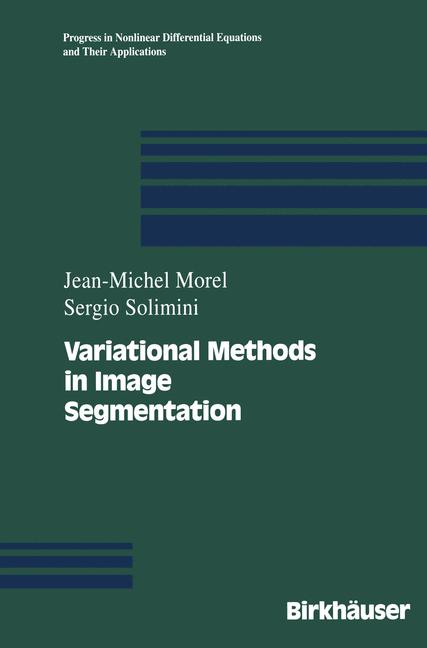
Variational Methods in Image Segmentation
☆☆☆☆☆
(0 reviews)
Lowest price (incl. delivery)
7 164,00 JPY
Typical price416,63 PLN
Lowest (90 days)44,99 PLN
Offers6
Last updated1 settimana fa
Price history (90 days)
Full history
2026-08-08
2026-08-15
| Aggiornato il | Prezzo |
|---|---|
| 2026-08-08 | 49,99 |
| 2026-08-14 | 44,99 |
| 2026-08-15 | 51,99 |
| Venditore | Product price | Delivery | Totale | Disponibilità | Updated | |
|---|---|---|---|---|---|---|
| SP SpringerNatureLink Shop INT | 7 149,00 JPY | 15,00 JPY | 7 164,00 JPY | Disponibile | 2 giorni fa | View offer |
| SP Springer Nature Author | 7 149,00 JPY | 19,00 JPY | 7 168,00 JPY | Disponibile | 1 settimana fa | View offer |
| SP SpringerNatureLink Shop INT | 49,99 USD | free | 49,99 USD | Disponibile | 2 giorni fa | View offer |
| SP SpringerNatureLink Shop INT | 54,99 USD | free | 54,99 USD | Disponibile | 2 giorni fa | View offer |
| SP SpringerNatureLink Shop INT | 54,99 USD | 29,00 USD | 83,99 USD | Disponibile | 2 giorni fa | View offer |
| SP SpringerNatureLink Shop INT | 59,00 EUR | 29,00 EUR | 88,00 EUR | Disponibile | 2 giorni fa | View offer |
I prezzi e la disponibilità possono variare. Ultimo aggiornamento: 08.08.2026 23:12.
0,0
☆☆☆☆☆
0 reviews
5★
0%
4★
0%
3★
0%
2★
0%
1★
0%
Product reviews
No reviews yet — be the first!
This book contains both a synthesis and mathematical analysis of a wide set of algorithms and theories whose aim is the automatic segmen tation of digital images as well as the understanding of visual perception. A common formalism for these theories and algorithms is obtained in a variational form. Thank to this formalization, mathematical questions about the soundness of algorithms can be raised and answered. Perception theory has to deal with the complex interaction between regions and "edges" (or boundaries) in an image: in the variational seg mentation energies, "edge" terms compete with "region" terms in a way which is supposed to impose regularity on both regions and boundaries. This fact was an experimental guess in perception phenomenology and computer vision until it was proposed as a mathematical conjecture by Mumford and Shah. The third part of the book presents a unified presentation of the evi dences in favour of the conjecture. It is proved that the competition of one-dimensional and two-dimensional energy terms in a variational for mulation cannot create fractal-like behaviour for the edges. The proof of regularity for the edges of a segmentation constantly involves con cepts from geometric measure theory, which proves to be central in im age processing theory. The second part of the book provides a fast and self-contained presentation of the classical theory of rectifiable sets (the "edges") and unrectifiable sets ("fractals").
Similar products
 50 Years of Philosophy and Medicine
from $107.30
50 Years of Philosophy and Medicine
from $107.30
 Understanding Cybersecurity Law and Digital Privacy
from $122.63
Understanding Cybersecurity Law and Digital Privacy
from $122.63
 Decisions in International Trade and Logistics
from $122.63
Decisions in International Trade and Logistics
from $122.63
 Advances in Economic Measurement
from $122.63
Advances in Economic Measurement
from $122.63
 Nanomaterials
from $137.96
Nanomaterials
from $137.96
 Sustainable Scaffolds-based Strategies in Tissue Engineering and Regenerative Medicine
from $162.87
Sustainable Scaffolds-based Strategies in Tissue Engineering and Regenerative Medicine
from $162.87
 Narratives in Educational Research
from $162.87
Narratives in Educational Research
from $162.87
 Environmental Biology of the Young Chinese Sturgeon
from $210.78
Environmental Biology of the Young Chinese Sturgeon
from $210.78