
Understanding Structural Equation Modeling
☆☆☆☆☆
(0 reviews)
Lowest price (incl. delivery)
31,49 USD
Typical price36,66 PLN
Lowest (90 days)26,21 PLN
Offers6
Last updated1 settimana fa
Price history (90 days)
Full history
2026-08-08
2026-08-14
| Aggiornato il | Prezzo |
|---|---|
| 2026-08-08 | 26,21 |
| 2026-08-14 | 26,21 |
| Venditore | Product price | Delivery | Totale | Disponibilità | Updated | |
|---|---|---|---|---|---|---|
| SP SpringerNatureLink Shop INT | 31,49 USD | free | 31,49 USD | Disponibile | 1 settimana fa | View offer |
| SP SpringerNatureLink Shop INT | 31,49 USD | 25,00 USD | 56,49 USD | Disponibile | 1 settimana fa | View offer |
| SP SpringerNatureLink Shop INT | 34,99 USD | 29,00 USD | 63,99 USD | Disponibile | 1 settimana fa | View offer |
| SP SpringerNatureLink Shop INT | 34,99 USD | 15,00 USD | 49,99 USD | Disponibile | 1 settimana fa | View offer |
| SP Springer Nature Author | 34,99 USD | 15,00 USD | 49,99 USD | Disponibile | 1 settimana fa | View offer |
| SP SpringerNatureLink Shop INT | 33,70 EUR | free | 33,70 EUR | Disponibile | 1 settimana fa | View offer |
I prezzi e la disponibilità possono variare. Ultimo aggiornamento: 08.08.2026 09:14.
0,0
☆☆☆☆☆
0 reviews
5★
0%
4★
0%
3★
0%
2★
0%
1★
0%
Product reviews
No reviews yet — be the first!
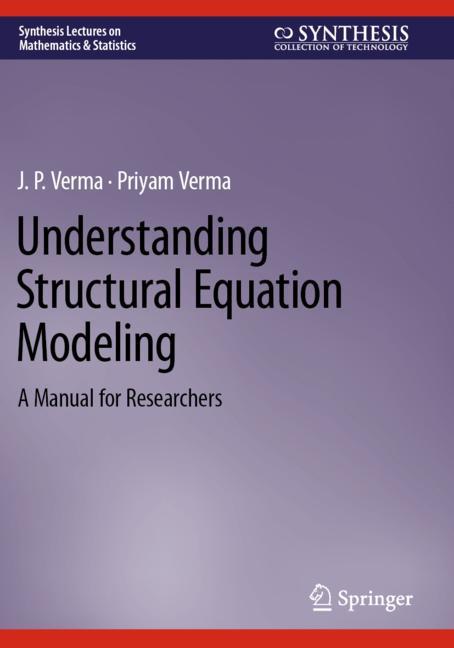
This book presents a comprehensive overview of Structural Equation Modeling and how it can be applied to address research issues in different disciplines. The authors employ a ‘simple to complex’ approach. The book reviews topics such as variance, covariance, correlation, multiple regression, mediation, moderation, path analysis, and confirmatory factor analysis. The authors then discuss the initial steps for performing structural equation modeling, including model specification, model identification, model estimation, model testing, and model modification. The book includes an introduction to the IBM SPSS and IBM SPSS Amos software. The authors the explain how this software can be utilized for developing measurement, structural models, and SEM models. The book provides conceptual clarity in understanding the models and discusses practical approaches to solving them. The authors also highlight how these techniques can be applied to various disciplines, including psychology, education,sociology, business, medicine, political science, and biological sciences.
Similar products
 50 Years of Philosophy and Medicine
from $107.30
50 Years of Philosophy and Medicine
from $107.30
 Understanding Cybersecurity Law and Digital Privacy
from $122.63
Understanding Cybersecurity Law and Digital Privacy
from $122.63
 Decisions in International Trade and Logistics
from $122.63
Decisions in International Trade and Logistics
from $122.63
 Advances in Economic Measurement
from $122.63
Advances in Economic Measurement
from $122.63
 Nanomaterials
from $137.96
Nanomaterials
from $137.96
 Sustainable Scaffolds-based Strategies in Tissue Engineering and Regenerative Medicine
from $162.87
Sustainable Scaffolds-based Strategies in Tissue Engineering and Regenerative Medicine
from $162.87
 Narratives in Educational Research
from $162.87
Narratives in Educational Research
from $162.87
 Environmental Biology of the Young Chinese Sturgeon
from $210.78
Environmental Biology of the Young Chinese Sturgeon
from $210.78