
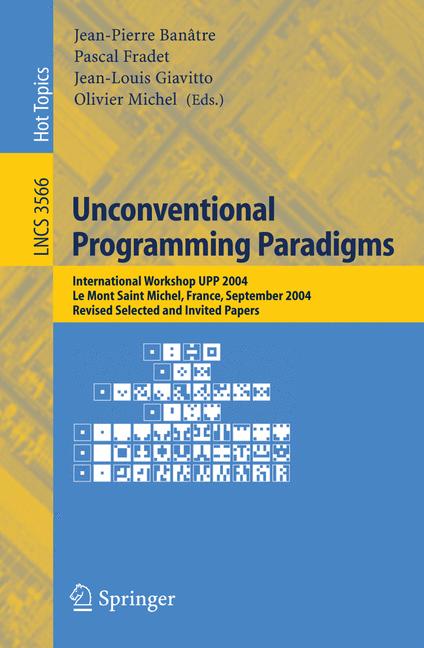
Unconventional Programming Paradigms
☆☆☆☆☆
(0 reviews)
Lowest price (incl. delivery)
39,99 USD
Typical price492,32 PLN
Lowest (90 days)35,99 PLN
Offers7
Last updated1 settimana fa
Price history (90 days)
Full history
2026-08-08
2026-08-15
| Aggiornato il | Prezzo |
|---|---|
| 2026-08-08 | 39,99 |
| 2026-08-14 | 35,99 |
| 2026-08-15 | 51,99 |
| Venditore | Product price | Delivery | Totale | Disponibilità | Updated | |
|---|---|---|---|---|---|---|
| SP SpringerNatureLink Shop INT | 39,99 USD | free | 39,99 USD | Disponibile | 1 settimana fa | View offer |
| SP SpringerNatureLink Shop INT | 7 149,00 JPY | 15,00 JPY | 7 164,00 JPY | Disponibile | 6 giorni fa | View offer |
| SP Springer Nature Author | 7 149,00 JPY | 15,00 JPY | 7 164,00 JPY | Disponibile | 1 settimana fa | View offer |
| SP SpringerNatureLink Shop INT | 49,99 USD | free | 49,99 USD | Disponibile | 1 settimana fa | View offer |
| SP SpringerNatureLink Shop INT | 54,99 USD | free | 54,99 USD | Disponibile | 1 settimana fa | View offer |
| SP SpringerNatureLink Shop INT | 54,99 USD | 19,00 USD | 73,99 USD | Disponibile | 1 settimana fa | View offer |
| SP SpringerNatureLink Shop INT | 59,00 EUR | free | 59,00 EUR | Disponibile | 1 settimana fa | View offer |
I prezzi e la disponibilità possono variare. Ultimo aggiornamento: 08.08.2026 23:09.
0,0
☆☆☆☆☆
0 reviews
5★
0%
4★
0%
3★
0%
2★
0%
1★
0%
Product reviews
No reviews yet — be the first!
Nowadays, developers have to face the proliferation of hardware and software environments, the increasing demands of the users, the growing number of p- grams and the sharing of information, competences and services thanks to the generalization ofdatabasesandcommunication networks. Aprogramisnomore a monolithic entity conceived, produced and ?nalized before being used. A p- gram is now seen as an open and adaptive frame, which, for example, can - namically incorporate services not foreseen by the initial designer. These new needs call for new control structures and program interactions. Unconventionalapproachestoprogramminghavelongbeendevelopedinv- iousnichesandconstituteareservoirofalternativewaystofacetheprogramming languages crisis. New models of programming (e. g. , bio-inspired computing, - ti?cialchemistry,amorphouscomputing,. . . )arealsocurrentlyexperiencinga renewed period of growth as they face speci?c needs and new application - mains. These approaches provide new abstractions and notations or develop new ways of interacting with programs. They are implemented by embedding new sophisticated data structures in a classical programming model (API), by extending an existing language with new constructs (to handle concurrency, - ceptions, open environments, . . . ), by conceiving new software life cycles and program executions (aspect weaving, run-time compilation) or by relying on an entire new paradigm to specify a computation. They are inspired by theoretical considerations (e. g. , topological, algebraic or logical foundations), driven by the domain at hand (domain-speci?c languages like PostScript, musical notation, animation, signal processing, etc. ) or by metaphors taken from various areas (quantum computing, computing with molecules, informationprocessing in - ological tissues, problem solving from nature, ethological and social modeling).
Similar products
 50 Years of Philosophy and Medicine
from $107.30
50 Years of Philosophy and Medicine
from $107.30
 Understanding Cybersecurity Law and Digital Privacy
from $122.63
Understanding Cybersecurity Law and Digital Privacy
from $122.63
 Decisions in International Trade and Logistics
from $122.63
Decisions in International Trade and Logistics
from $122.63
 Advances in Economic Measurement
from $122.63
Advances in Economic Measurement
from $122.63
 Nanomaterials
from $137.96
Nanomaterials
from $137.96
 Sustainable Scaffolds-based Strategies in Tissue Engineering and Regenerative Medicine
from $162.87
Sustainable Scaffolds-based Strategies in Tissue Engineering and Regenerative Medicine
from $162.87
 Narratives in Educational Research
from $162.87
Narratives in Educational Research
from $162.87
 Environmental Biology of the Young Chinese Sturgeon
from $210.78
Environmental Biology of the Young Chinese Sturgeon
from $210.78