
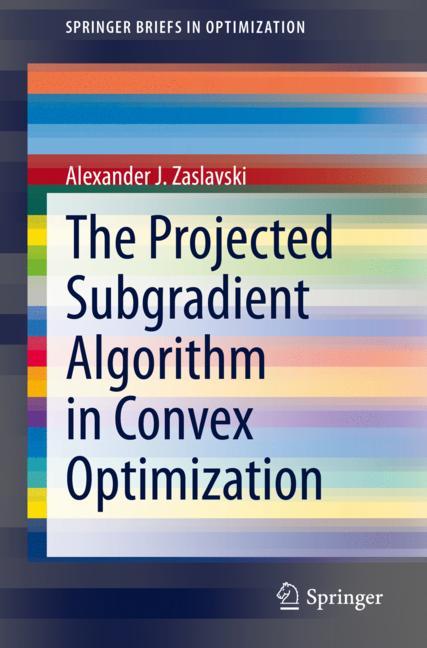
The Projected Subgradient Algorithm in Convex Optimization
☆☆☆☆☆
(0 reviews)
Lowest price (incl. delivery)
7 164,00 JPY
Typical price314,07 PLN
Lowest (90 days)39,99 PLN
Offers2
Last updated22 ore fa
| Venditore | Product price | Delivery | Totale | Disponibilità | Updated | |
|---|---|---|---|---|---|---|
| SP Springer Nature Author | 7 149,00 JPY | 15,00 JPY | 7 164,00 JPY | Disponibile | 22 ore fa | View offer |
| SP SpringerNatureLink Shop INT | 59,00 EUR | free | 59,00 EUR | Disponibile | 1 giorno fa | View offer |
I prezzi e la disponibilità possono variare. Ultimo aggiornamento: 08.08.2026 23:08.
0,0
☆☆☆☆☆
0 reviews
5★
0%
4★
0%
3★
0%
2★
0%
1★
0%
Product reviews
No reviews yet — be the first!
This focused monograph presents a study of subgradient algorithms for constrained minimization problems in a Hilbert space. The book is of interest for experts in applications of optimization to engineering and economics. The goal is to obtain a good approximate solution of the problem in the presence of computational errors. The discussion takes into consideration the fact that for every algorithm its iteration consists of several steps and that computational errors for different steps are different, in general. The book is especially useful for the reader because it contains solutions to a number of difficult and interesting problems in the numerical optimization. The subgradient projection algorithm is one of the most important tools in optimization theory and its applications. An optimization problem is described by an objective function and a set of feasible points. For this algorithm each iteration consists of two steps. The first step requires a calculation of a subgradient of the objective function; the second requires a calculation of a projection on the feasible set. The computational errors in each of these two steps are different. This book shows that the algorithm discussed, generates a good approximate solution, if all the computational errors are bounded from above by a small positive constant. Moreover, if computational errors for the two steps of the algorithm are known, one discovers an approximate solution and how many iterations one needs for this. In addition to their mathematical interest, the generalizations considered in this book have a significant practical meaning.
Similar products
 Patient Safety Coaching
from $91.97
Patient Safety Coaching
from $91.97
 Ethnography and Diversity
from $69.30
Ethnography and Diversity
from $69.30
 Smart Villages
from $91.97
Smart Villages
from $91.97
 Nuclear Non-Proliferation in International Law - Volume VI
from $91.97
Nuclear Non-Proliferation in International Law - Volume VI
from $91.97
 The Price of Freedom
from $91.97
The Price of Freedom
from $91.97
 Eco-Social Policy in the OECD and the World Bank
from $91.97
Eco-Social Policy in the OECD and the World Bank
from $91.97
 Special Topics in Policing
from $122.58
Special Topics in Policing
from $122.58
 Music from the Heart
from $91.97
Music from the Heart
from $91.97