
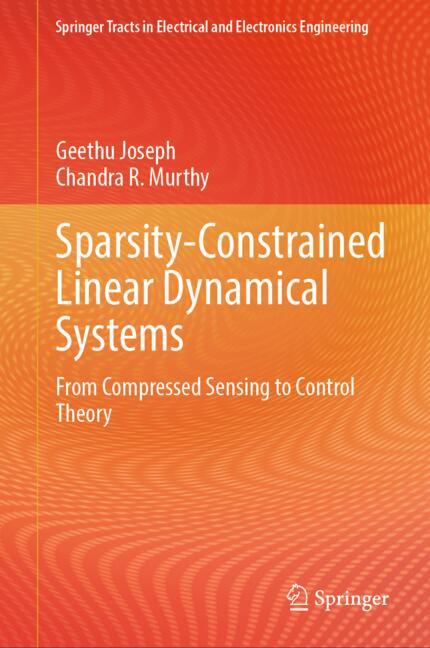
Sparsity-Constrained Linear Dynamical Systems
☆☆☆☆☆
(0 reviews)
Lowest price (incl. delivery)
14 900,00 JPY
Typical price4 371,82 PLN
Lowest (90 days)111,27 PLN
Offers4
Last updated4 giorni fa
Price history (90 days)
Full history
2026-08-08
2026-08-15
| Aggiornato il | Prezzo |
|---|---|
| 2026-08-08 | 111,27 |
| 2026-08-15 | 123,00 |
| Venditore | Product price | Delivery | Totale | Disponibilità | Updated | |
|---|---|---|---|---|---|---|
| SP SpringerNatureLink Shop INT | 14 871,00 JPY | 29,00 JPY | 14 900,00 JPY | Disponibile | 4 giorni fa | View offer |
| SP Springer Nature Author | 14 871,00 JPY | free | 14 871,00 JPY | Disponibile | 1 settimana fa | View offer |
| SP SpringerNatureLink Shop INT | 111,27 USD | 15,00 USD | 126,27 USD | Disponibile | 4 giorni fa | View offer |
| SP SpringerNatureLink Shop INT | 123,00 EUR | 25,00 EUR | 148,00 EUR | Disponibile | 4 giorni fa | View offer |
I prezzi e la disponibilità possono variare. Ultimo aggiornamento: 15.08.2026 04:40.
EAN
9789819770908
Springer Nature
0,0
☆☆☆☆☆
0 reviews
5★
0%
4★
0%
3★
0%
2★
0%
1★
0%
Product reviews
No reviews yet — be the first!
This volume provides a comprehensive overview of recent research advances in the upcoming field of sparse control and state estimation of linear dynamical systems. The contents offer a detailed introduction to the subject by combining classical control theory and compressed sensing. It covers conceptual foundations, including the formulation, theory, and algorithms, and outlines numerous remaining research challenges. Specifically, the book provides a detailed discussion on observability, controllability, and stabilizability under sparsity constraints. It also presents efficient, systematic, and rigorous approaches to estimating the sparse initial states and designing sparse control inputs. It also gives background materials from real analysis and probability theory and includes applications in network control, wireless communication, and image processing. It serves as a compendious source for graduate students and researchers in signal processing and control systems to acquire a thorough understanding of the underlying unified themes. The academic and industrial professionals working on the design and optimization of sparsity-constrained systems also benefit from the exposure to the array of recent works on linear dynamical systems and related mathematical machinery.
Similar products
 50 Years of Philosophy and Medicine
from $107.30
50 Years of Philosophy and Medicine
from $107.30
 Understanding Cybersecurity Law and Digital Privacy
from $122.63
Understanding Cybersecurity Law and Digital Privacy
from $122.63
 Decisions in International Trade and Logistics
from $122.63
Decisions in International Trade and Logistics
from $122.63
 Advances in Economic Measurement
from $122.63
Advances in Economic Measurement
from $122.63
 Nanomaterials
from $137.96
Nanomaterials
from $137.96
 Sustainable Scaffolds-based Strategies in Tissue Engineering and Regenerative Medicine
from $162.87
Sustainable Scaffolds-based Strategies in Tissue Engineering and Regenerative Medicine
from $162.87
 Narratives in Educational Research
from $162.87
Narratives in Educational Research
from $162.87
 Environmental Biology of the Young Chinese Sturgeon
from $210.78
Environmental Biology of the Young Chinese Sturgeon
from $210.78