
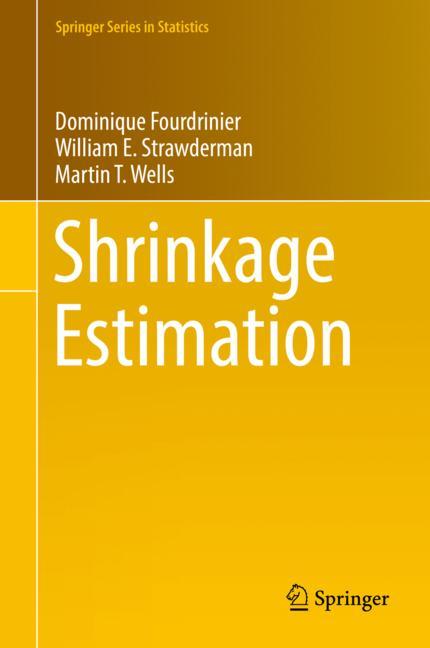
Shrinkage Estimation
☆☆☆☆☆
(0 reviews)
Lowest price (incl. delivery)
128,50 GBP
Typical price3 091,54 PLN
Lowest (90 days)117,69 PLN
Offers2
Last updated2 giorni fa
| Venditore | Product price | Delivery | Totale | Disponibilità | Updated | |
|---|---|---|---|---|---|---|
| SP SpringerNatureLink Shop INT | 103,50 GBP | 25,00 GBP | 128,50 GBP | Disponibile | 2 giorni fa | View offer |
| SP Springer Nature Author | 21 449,00 JPY | 15,00 JPY | 21 464,00 JPY | Disponibile | 2 giorni fa | View offer |
I prezzi e la disponibilità possono variare. Ultimo aggiornamento: 08.08.2026 23:28.
0,0
☆☆☆☆☆
0 reviews
5★
0%
4★
0%
3★
0%
2★
0%
1★
0%
Product reviews
No reviews yet — be the first!
This book provides a coherent framework for understanding shrinkage estimation in statistics. The term refers to modifying a classical estimator by moving it closer to a target which could be known a priori or arise from a model. The goal is to construct estimators with improved statistical properties. The book focuses primarily on point and loss estimation of the mean vector of multivariate normal and spherically symmetric distributions. Chapter 1 reviews the statistical and decision theoretic terminology and results that will be used throughout the book. Chapter 2 is concerned with estimating the mean vector of a multivariate normal distribution under quadratic loss from a frequentist perspective. In Chapter 3 the authors take a Bayesian view of shrinkage estimation in the normal setting. Chapter 4 introduces the general classes of spherically and elliptically symmetric distributions. Point and loss estimation for these broad classes are studied in subsequent chapters. In particular, Chapter 5 extends many of the results from Chapters 2 and 3 to spherically and elliptically symmetric distributions. Chapter 6 considers the general linear model with spherically symmetric error distributions when a residual vector is available. Chapter 7 then considers the problem of estimating a location vector which is constrained to lie in a convex set. Much of the chapter is devoted to one of two types of constraint sets, balls and polyhedral cones. In Chapter 8 the authors focus on loss estimation and data-dependent evidence reports. Appendices cover a number of technical topics including weakly differentiable functions; examples where Stein’s identity doesn’t hold; Stein’s lemma and Stokes’ theorem for smooth boundaries; harmonic, superharmonic and subharmonic functions; and modified Bessel functions.
Similar products
 Patient Safety Coaching
from $91.97
Patient Safety Coaching
from $91.97
 Ethnography and Diversity
from $69.30
Ethnography and Diversity
from $69.30
 Smart Villages
from $91.97
Smart Villages
from $91.97
 Nuclear Non-Proliferation in International Law - Volume VI
from $91.97
Nuclear Non-Proliferation in International Law - Volume VI
from $91.97
 The Price of Freedom
from $91.97
The Price of Freedom
from $91.97
 Eco-Social Policy in the OECD and the World Bank
from $91.97
Eco-Social Policy in the OECD and the World Bank
from $91.97
 Special Topics in Policing
from $122.58
Special Topics in Policing
from $122.58
 Music from the Heart
from $91.97
Music from the Heart
from $91.97