
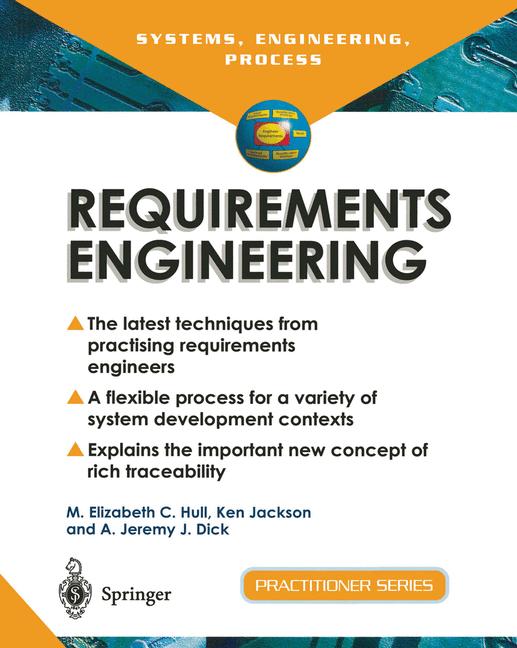
Requirements Engineering
☆☆☆☆☆
(0 reviews)
Lowest price (incl. delivery)
9 166,00 JPY
Typical price981,80 PLN
Lowest (90 days)56,99 PLN
Offers3
Last updated1 settimana fa
Price history (90 days)
Full history
2026-08-08
2026-08-15
| Aggiornato il | Prezzo |
|---|---|
| 2026-08-08 | 56,99 |
| 2026-08-15 | 56,99 |
| Venditore | Product price | Delivery | Totale | Disponibilità | Updated | |
|---|---|---|---|---|---|---|
| SP SpringerNatureLink Shop INT | 9 151,00 JPY | 15,00 JPY | 9 166,00 JPY | Disponibile | 4 giorni fa | View offer |
| SP Springer Nature Author | 9 151,00 JPY | 15,00 JPY | 9 166,00 JPY | Disponibile | 1 settimana fa | View offer |
| SP SpringerNatureLink Shop INT | 85,00 EUR | 19,00 EUR | 104,00 EUR | Disponibile | 4 giorni fa | View offer |
I prezzi e la disponibilità possono variare. Ultimo aggiornamento: 08.08.2026 23:18.
EAN
9781447137306
Springer Nature
0,0
☆☆☆☆☆
0 reviews
5★
0%
4★
0%
3★
0%
2★
0%
1★
0%
Product reviews
No reviews yet — be the first!
We live in a commercial world where much of our work is undertaken through a project -oriented approach. This has the advantage of determining the cost and time of the project to be undertaken, which in their turn are based on the knowledge of what the project is to deliver. Computing is no different in this regard, and so in order to organize our activities, we need to know what it is that is to be delivered. Hence Requirements Engineering, an organized approach to determining what is required in the project/ system that is being undertaken. There are some problems with the idea of Requirements Engineering, which I have on previous occasions encapsulated in a single sentence called 'The Mock Theorem of Information Systems' which states 'There exists some point in time when everyone involved in the system knows what they want and agrees with everyone else' Clearly nonsense (how would you know what everyone is agreeing to for example?). But in order to build a system on a project basis, this sentence has to be assumed to be true (either explicitly, or even worse, implicitly). Then Requirements Engineering can be made to work, and the correct prod uct/ system delivered by the project. However, we do not have an established alternative to the project approach, and the business world is used to projects. So Requirements Engineering is necessary, but it needs tempering to allow for the desired certainty actually being unknown.
Similar products
 50 Years of Philosophy and Medicine
from $107.30
50 Years of Philosophy and Medicine
from $107.30
 Understanding Cybersecurity Law and Digital Privacy
from $122.63
Understanding Cybersecurity Law and Digital Privacy
from $122.63
 Decisions in International Trade and Logistics
from $122.63
Decisions in International Trade and Logistics
from $122.63
 Advances in Economic Measurement
from $122.63
Advances in Economic Measurement
from $122.63
 Nanomaterials
from $137.96
Nanomaterials
from $137.96
 Sustainable Scaffolds-based Strategies in Tissue Engineering and Regenerative Medicine
from $162.87
Sustainable Scaffolds-based Strategies in Tissue Engineering and Regenerative Medicine
from $162.87
 Narratives in Educational Research
from $162.87
Narratives in Educational Research
from $162.87
 Environmental Biology of the Young Chinese Sturgeon
from $210.78
Environmental Biology of the Young Chinese Sturgeon
from $210.78