
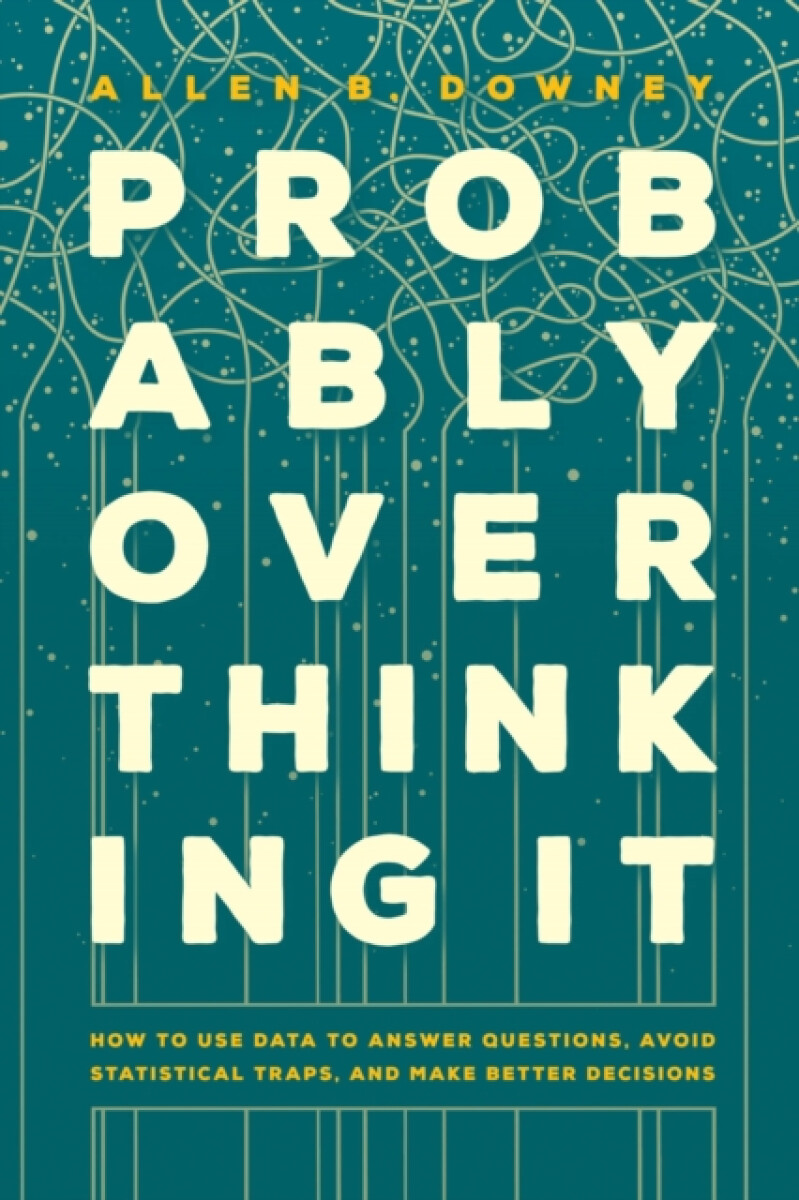
Probably Overthinking It – How to Use Data to Answer Questions, Avoid Statistical Traps, and Make Better Decisions - Allen B. Downey
☆☆☆☆☆
(0 reviews)
Lowest price (incl. delivery)
660,00 CZK
Typical price153,26 PLN
Lowest (90 days)15,20 PLN
Offers3
Last updated1 settimana fa
Price history (90 days)
Full history
2026-08-07
2026-08-08
| Aggiornato il | Prezzo |
|---|---|
| 2026-08-07 | 15,20 |
| 2026-08-08 | 288,42 |
| Venditore | Product price | Delivery | Totale | Disponibilità | Updated | |
|---|---|---|---|---|---|---|
| KN KnihyDobrovsky.cz | 660,00 CZK | free | 660,00 CZK | Disponibile | 2 giorni fa | View offer |
| KN Knetbooks.com | 31,79 USD | 29,00 USD | 60,79 USD | Disponibile | 1 settimana fa | View offer |
| VI VitalSource | 288,42 ZAR | 29,00 ZAR | 317,42 ZAR | Disponibile | 1 settimana fa | View offer |
I prezzi e la disponibilità possono variare. Ultimo aggiornamento: 08.08.2026 05:47.
EAN
9780226822587
University of Chicago Press
0,0
☆☆☆☆☆
0 reviews
5★
0%
4★
0%
3★
0%
2★
0%
1★
0%
Product reviews
No reviews yet — be the first!
An essential guide to the ways data can improve decision making.  Statistics are everywhere: in news reports, at the doctor’s office, and in every sort of forecast, from the stock market to the weather. Blogger, teacher, and computer scientist Allen B. Downey knows well that people have an innate ability both to understand statistics and to be fooled by them. As he makes clear in this accessible introduction to statistical thinking, the stakes are big. Simple misunderstandings have led to incorrect medical prognoses, underestimated the likelihood of large earthquakes, hindered social justice efforts, and resulted in dubious policy decisions. There are right and wrong ways to look at numbers, and Downey will help you see which are which.  Probably Overthinking It uses real data to delve into real examples with real consequences, drawing on cases from health campaigns, political movements, chess rankings, and more. He lays out common pitfalls—like the base rate fallacy, length-biased sampling, and Simpson’s paradox—and shines a light on what we learn when we interpret data correctly, and what goes wrong when we don’t. Using data visualizations instead of equations, he builds understanding from the basics to help you recognize errors, whether in your own thinking or in media reports. Even if you have never studied statistics—or if you have and forgot everything you learned—this book will offer new insight into the methods and measurements that help us understand the world.
Similar products
 Sustainable Development
from $2,281.25
Sustainable Development
from $2,281.25
 Author Title and Subject Guide
from $1,780.26
Author Title and Subject Guide
from $1,780.26
 Debating Issues in American Education
from $825.02
Debating Issues in American Education
from $825.02
 Karl Popper
from $1,978.07
Karl Popper
from $1,978.07
 Encyclopedia of Journalism
from $1,058.62
Encyclopedia of Journalism
from $1,058.62
 NUR 110 Print+Ebook Bundle
from $1,908.35
NUR 110 Print+Ebook Bundle
from $1,908.35
 GMR Springfield Paramedic 9E Flipped Bundle Updated .
from $1,382.58
Nursing Volume 1 & 2 with Clinical Nursing Skills Volume 3 & MyNursingLab Package
from $1,183.17
GMR Springfield Paramedic 9E Flipped Bundle Updated .
from $1,382.58
Nursing Volume 1 & 2 with Clinical Nursing Skills Volume 3 & MyNursingLab Package
from $1,183.17