
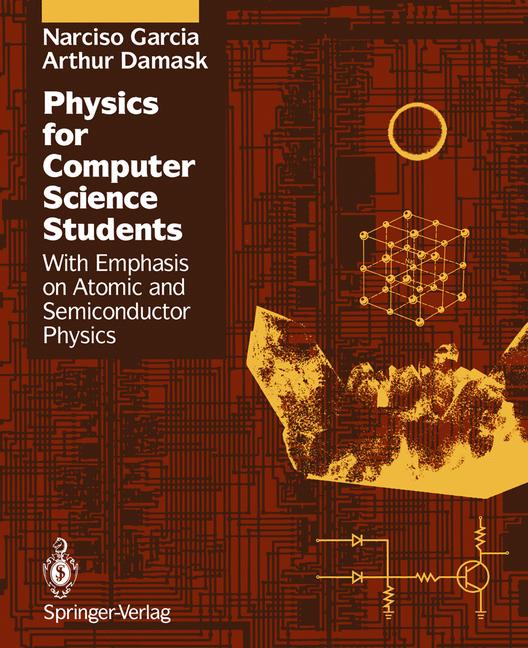
Physics for Computer Science Students
☆☆☆☆☆
(0 reviews)
Lowest price (incl. delivery)
9 171,00 JPY
Typical price78,00 PLN
Lowest (90 days)56,99 PLN
Offers3
Last updated6 giorni fa
Price history (90 days)
Full history
2026-08-08
2026-08-15
| Aggiornato il | Prezzo |
|---|---|
| 2026-08-08 | 85,00 |
| 2026-08-15 | 56,99 |
| Venditore | Product price | Delivery | Totale | Disponibilità | Updated | |
|---|---|---|---|---|---|---|
| SP SpringerNatureLink Shop INT | 9 146,00 JPY | 25,00 JPY | 9 171,00 JPY | Disponibile | 6 giorni fa | View offer |
| SP Springer Nature Author | 56,99 GBP | 25,00 GBP | 81,99 GBP | Disponibile | 1 settimana fa | View offer |
| SP SpringerNatureLink Shop INT | 85,00 EUR | 29,00 EUR | 114,00 EUR | Disponibile | 6 giorni fa | View offer |
I prezzi e la disponibilità possono variare. Ultimo aggiornamento: 15.08.2026 07:54.
EAN
9781468404210
Springer Nature
0,0
☆☆☆☆☆
0 reviews
5★
0%
4★
0%
3★
0%
2★
0%
1★
0%
Product reviews
No reviews yet — be the first!
This text is the product of several years' effort to develop a course to fill a specific educational gap. It is our belief that computer science students should know how a computer works, particularly in light of rapidly changing tech nologies. The text was designed for computer science students who have a calculus background but have not necessarily taken prior physics courses. However, it is clearly not limited to these students. Anyone who has had first-year physics can start with Chapter 17. This includes all science and engineering students who would like a survey course of the ideas, theories, and experiments that made our modern electronics age possible. This textbook is meant to be used in a two-semester sequence. Chapters 1 through 16 can be covered during the first semester, and Chapters 17 through 28 in the second semester. At Queens College, where preliminary drafts have been used, the material is presented in three lecture periods (50 minutes each) and one recitation period per week, 15 weeks per semester. The lecture and recitation are complemented by a two-hour laboratory period per week for the first semester and a two-hour laboratory period biweekly for the second semester.
Similar products
 Gamma Knife Neurosurgery in the Management of Intracranial Disorders
from $210.78
Gamma Knife Neurosurgery in the Management of Intracranial Disorders
from $210.78
 SDGs in Construction Economics and Organization
from $210.78
SDGs in Construction Economics and Organization
from $210.78
 Emerging Therapies in Neurorehabilitation III
from $210.78
Emerging Therapies in Neurorehabilitation III
from $210.78
 Ground Improvement Techniques
from $220.36
Ground Improvement Techniques
from $220.36
 Anomaly Detection in Video Surveillance
from $220.36
Anomaly Detection in Video Surveillance
from $220.36
 Mechanism and Machine Science
from $287.42
Mechanism and Machine Science
from $287.42
 Protein-Protein Interactions as New Drug Targets
from $287.42
Protein-Protein Interactions as New Drug Targets
from $287.42
 Proceedings of the 7th International Conference of Transportation Research Group of India (CTRG 2023
from $287.42
Proceedings of the 7th International Conference of Transportation Research Group of India (CTRG 2023
from $287.42