
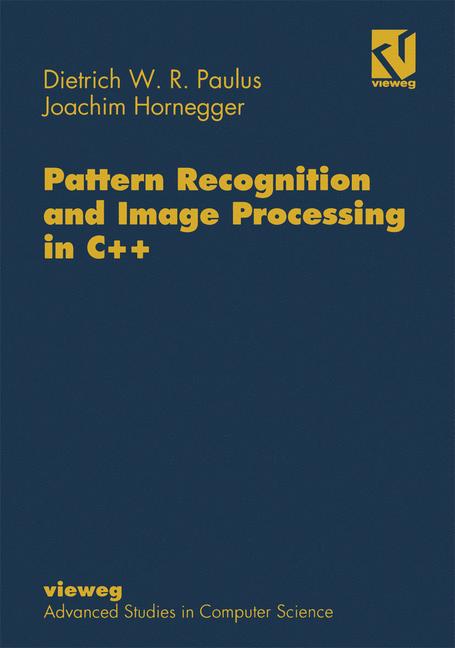
Pattern Recognition and Image Processing in C++
☆☆☆☆☆
(0 reviews)
Lowest price (incl. delivery)
17 174,00 JPY
Typical price2 969,36 PLN
Lowest (90 days)124,79 PLN
Offers2
Last updated6 giorni fa
| Venditore | Product price | Delivery | Totale | Disponibilità | Updated | |
|---|---|---|---|---|---|---|
| SP Springer Nature Author | 17 159,00 JPY | 15,00 JPY | 17 174,00 JPY | Disponibile | 6 giorni fa | View offer |
| SP SpringerNatureLink Shop INT | 109,99 GBP | free | 109,99 GBP | Disponibile | 6 giorni fa | View offer |
I prezzi e la disponibilità possono variare. Ultimo aggiornamento: 08.08.2026 23:28.
0,0
☆☆☆☆☆
0 reviews
5★
0%
4★
0%
3★
0%
2★
0%
1★
0%
Product reviews
No reviews yet — be the first!
Parts of this text were used for several years by students in a one~term under graduate course in computer science. The students had to prepare projects in small groups (2~4 students).1 This book emphasizes practical experience with image processing. It offers a comprehensive study of • image processing and image analysis, • basics of speech processing, • object~oriented programming, • software design, • and programming in C++. The book is divided into four parts. In the first part we introduce image processing, image analysis, programming tools, and the basics of C++. In the second part we describe object~oriented programming in general and the possible applications of object~oriented concepts in C++. Several appli cations of object~oriented programming for image processing are discussed as well. The new features of C++ are introduced entirely through the use of examples. We cover the proper representation of the data that is a result of pattern analysis as well. The third part describes a complete system for image segmentation. Some of the material covered refers to the exercises found in the first and second parts: this verifies our belief that an image segmentation system of programs can be developed while simultaneously acquainting others to C++. We combine the data representation described in the second part with the algorithms that use and manipulate them here in the third part.
Similar products
 Electroencephalogram for Presurgical Epilepsy Evaluation
from $131.45
Electroencephalogram for Presurgical Epilepsy Evaluation
from $131.45
 Decarbonization Policy Toward Asia Zero Emission Community
from $131.45
Decarbonization Policy Toward Asia Zero Emission Community
from $131.45
 Dirty Hearts
from $112.32
Dirty Hearts
from $112.32
 Climate Finance in the Net-Zero Transition
from $112.32
Climate Finance in the Net-Zero Transition
from $112.32
 Pan-African Artificial Intelligence and Smart Systems
from $112.32
Pan-African Artificial Intelligence and Smart Systems
from $112.32
 Corporate Psychopaths
from $133.35
Corporate Psychopaths
from $133.35
 Artificial Intelligence in Healthcare
from $105.99
Artificial Intelligence in Healthcare
from $105.99
 Ästhetische Grundbegriffe
from $114.48
Ästhetische Grundbegriffe
from $114.48