
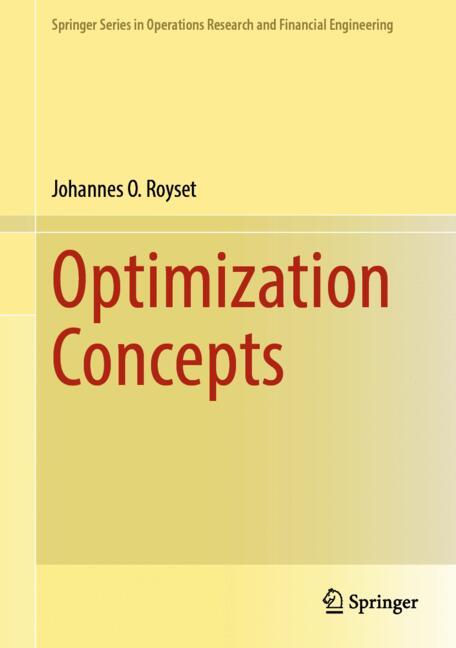
Optimization Concepts
☆☆☆☆☆
(0 reviews)
Lowest price (incl. delivery)
71,00 EUR
Typical price67,46 PLN
Lowest (90 days)65,39 PLN
Offers1
Last updated3 ore fa
| Venditore | Product price | Delivery | Totale | Disponibilità | Updated | |
|---|---|---|---|---|---|---|
| SP SpringerNatureLink Shop INT | 71,00 EUR | free | 71,00 EUR | Disponibile | 3 ore fa | View offer |
I prezzi e la disponibilità possono variare. Ultimo aggiornamento: 15.08.2026 01:42.
EAN
9783032368188
Springer Nature
0,0
☆☆☆☆☆
0 reviews
5★
0%
4★
0%
3★
0%
2★
0%
1★
0%
Product reviews
No reviews yet — be the first!
This book provides a clear, modern, and application‑driven introduction to mathematical optimization—one of the central technologies underlying today’s data‑driven decision making. Designed for students and practitioners encountering optimization for the first time, the book develops core concepts through intuitive explanations, concrete examples, and algorithmic insights, while maintaining mathematical rigor where it matters. Beginning with smooth unconstrained problems, the text builds a unified framework connecting calculus, convexity, and optimality conditions. It progresses naturally to constrained and nonsmooth optimization, introducing subgradients, normal cones, and the Karush–Kuhn–Tucker condition in an accessible and coherent manner. Along the way, readers learn how fundamental algorithms—such as gradient, Newton’s, and simplex methods—emerge from the underlying theory and how they behave in practice. The book places strong emphasis on modeling, guiding readers from real‑world problems to optimization formulations and solution strategies. Topics include linear and quadratic programming, network and integer structures, and optimization under uncertainty. Applications are drawn from engineering, operations research, data science, machine learning, and analytics, illustrating how optimization serves as a unifying language across disciplines. Written as lecture notes for a one‑semester introductory course, this book assumes only basic knowledge of calculus and linear algebra. It builds intuition, vocabulary, and mathematical comprehension, while largely avoiding formal proofs. Numerous worked examples, exercises, and fully solved problems support self‑study and classroom use. This book is ideal for advanced undergraduate students, master’s students, and practitioners seeking a principled yet approachable introduction to optimization, as well as a foundation for further study in applied mathematics, operations research, and analytics.
Similar products
 Sustainable Practices in Higher Education
from $156.21
Sustainable Practices in Higher Education
from $156.21
 I Want to be a Mathematician
from $156.21
I Want to be a Mathematician
from $156.21
 Security and Quality in Cyber-Physical Systems Engineering
from $156.21
Security and Quality in Cyber-Physical Systems Engineering
from $156.21
 Issues in Contemporary Oil Paint
from $156.21
Issues in Contemporary Oil Paint
from $156.21
 Basic Principles of Membrane Technology
from $156.21
Basic Principles of Membrane Technology
from $156.21
 Accessibility, Gender, and Social Safety Net Program
from $135.42
Accessibility, Gender, and Social Safety Net Program
from $135.42
 Grey Systems Analysis
from $135.42
Grey Systems Analysis
from $135.42
 Cisgenic Crops: Safety, Legal and Social Issues
from $135.42
Cisgenic Crops: Safety, Legal and Social Issues
from $135.42