
Multi-axis Substructure Testing System for Hybrid Simulation
☆☆☆☆☆
(0 reviews)
Lowest price (incl. delivery)
54,99 USD
Typical price563,10 PLN
Lowest (90 days)34,99 PLN
Offers7
Last updated1 settimana fa
Price history (90 days)
Full history
2026-08-08
2026-08-15
| Aggiornato il | Prezzo |
|---|---|
| 2026-08-08 | 39,99 |
| 2026-08-14 | 34,99 |
| 2026-08-15 | 51,99 |
| Venditore | Product price | Delivery | Totale | Disponibilità | Updated | |
|---|---|---|---|---|---|---|
| SP SpringerNatureLink Shop INT | 39,99 USD | 15,00 USD | 54,99 USD | Disponibile | 4 giorni fa | View offer |
| SP SpringerNatureLink Shop INT | 7 149,00 JPY | 25,00 JPY | 7 174,00 JPY | Disponibile | 4 giorni fa | View offer |
| SP Springer Nature Author | 7 149,00 JPY | free | 7 149,00 JPY | Disponibile | 1 settimana fa | View offer |
| SP SpringerNatureLink Shop INT | 49,99 USD | 19,00 USD | 68,99 USD | Disponibile | 4 giorni fa | View offer |
| SP SpringerNatureLink Shop INT | 54,99 USD | free | 54,99 USD | Disponibile | 4 giorni fa | View offer |
| SP SpringerNatureLink Shop INT | 54,99 USD | free | 54,99 USD | Disponibile | 4 giorni fa | View offer |
| SP SpringerNatureLink Shop INT | 59,00 EUR | 15,00 EUR | 74,00 EUR | Disponibile | 4 giorni fa | View offer |
I prezzi e la disponibilità possono variare. Ultimo aggiornamento: 08.08.2026 23:09.
0,0
☆☆☆☆☆
0 reviews
5★
0%
4★
0%
3★
0%
2★
0%
1★
0%
Product reviews
No reviews yet — be the first!
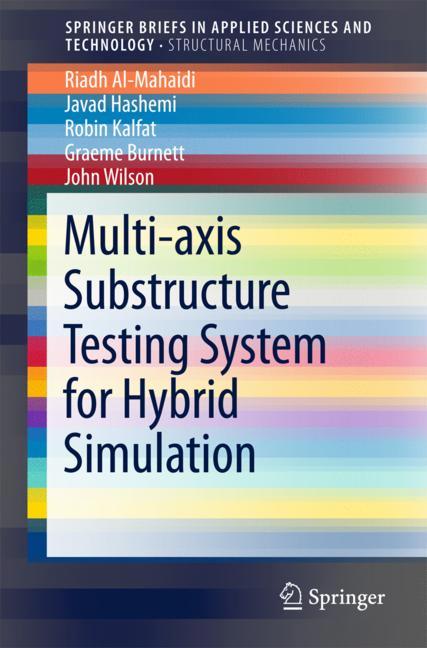
This book describes the multi-axis substructure testing (MAST) system, a simulator developed at Swinburne University of Technology, Australia, which provides state-of-the-art technology for large-scale hybrid testing of structures under realistic scenarios depicting extreme events. The book also demonstrates the responses of physical specimens while they serve as part of the virtual computer model of the full structure subjected to extreme dynamic forces. Experimental studies using the MAST system are expected to enhance design and construction methods and significantly improve the repair and retrofitting of structures endangered by natural disasters and man-made hazards, providing a direct benefit to society by improving public safety and the re silience of the built environment. An additional benefit is increased sustainability in the form of reduced direct and indirect economic losses and social and environmental impacts in the face of extreme events. This book will beof interest to researchers and advanced practitioners in the fields of structural earthquake engineering, geotechnical earthquake engineering, engineering seismology, and experimental dynamics, including seismic qualification.
Similar products
 50 Years of Philosophy and Medicine
from $107.30
50 Years of Philosophy and Medicine
from $107.30
 Understanding Cybersecurity Law and Digital Privacy
from $122.63
Understanding Cybersecurity Law and Digital Privacy
from $122.63
 Decisions in International Trade and Logistics
from $122.63
Decisions in International Trade and Logistics
from $122.63
 Advances in Economic Measurement
from $122.63
Advances in Economic Measurement
from $122.63
 Nanomaterials
from $137.96
Nanomaterials
from $137.96
 Sustainable Scaffolds-based Strategies in Tissue Engineering and Regenerative Medicine
from $162.87
Sustainable Scaffolds-based Strategies in Tissue Engineering and Regenerative Medicine
from $162.87
 Narratives in Educational Research
from $162.87
Narratives in Educational Research
from $162.87
 Environmental Biology of the Young Chinese Sturgeon
from $210.78
Environmental Biology of the Young Chinese Sturgeon
from $210.78