
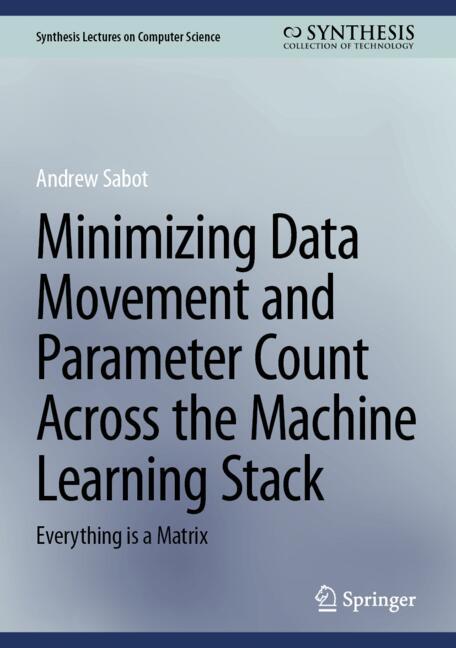
Minimizing Data Movement and Parameter Count Across the Machine Learning Stack
☆☆☆☆☆
(0 reviews)
Lowest price (incl. delivery)
5 744,00 JPY
Typical price1 984,26 PLN
Lowest (90 days)27,99 PLN
Offers6
Last updated1 settimana fa
Price history (90 days)
Full history
2026-08-08
2026-08-15
| Aggiornato il | Prezzo |
|---|---|
| 2026-08-08 | 32,09 |
| 2026-08-14 | 27,99 |
| 2026-08-15 | 5 719,00 |
| Venditore | Product price | Delivery | Totale | Disponibilità | Updated | |
|---|---|---|---|---|---|---|
| SP SpringerNatureLink Shop INT | 5 719,00 JPY | 25,00 JPY | 5 744,00 JPY | Disponibile | 3 giorni fa | View offer |
| SP Springer Nature Author | 5 719,00 JPY | 29,00 JPY | 5 748,00 JPY | Disponibile | 1 settimana fa | View offer |
| SP SpringerNatureLink Shop INT | 39,99 USD | free | 39,99 USD | Disponibile | 4 giorni fa | View offer |
| SP SpringerNatureLink Shop INT | 44,99 USD | free | 44,99 USD | Disponibile | 4 giorni fa | View offer |
| SP SpringerNatureLink Shop INT | 44,99 USD | 29,00 USD | 73,99 USD | Disponibile | 4 giorni fa | View offer |
| SP SpringerNatureLink Shop INT | 43,99 EUR | 29,00 EUR | 72,99 EUR | Disponibile | 4 giorni fa | View offer |
I prezzi e la disponibilità possono variare. Ultimo aggiornamento: 08.08.2026 08:53.
0,0
☆☆☆☆☆
0 reviews
5★
0%
4★
0%
3★
0%
2★
0%
1★
0%
Product reviews
No reviews yet — be the first!
This book provides a focused, research-forward guide to making large AI models efficient in practice and also presents an array of novel techniques to reduce memory footprint, accelerate computation, and improve overall hardware utilization. The author demonstrates that substantial efficiency gains can be achieved by rethinking how data is computed, stored, and compressed, with a special focus on matrices, the core computational structure underpinning both scientific computing and neural networks. Modern AI models run on huge grids of numbers (matrices/tensors), and their speed and affordability depend on how those numbers are arranged and processed on real hardware (GPUs/TPUs/CPUs). This book explains practical methods to skip unnecessary work (structured sparsity), move data efficiently (gather/scatter), and shrink models without losing accuracy (block distillation) so that AI systems can use less memory, less time, and less energy without sacrificing quality. In addition, the book shows how to turn algorithmic ideas into hardware-aware speedups on GPUs/TPUs. Readers will learn when sparsity pays off, how to schedule irregular workloads, and how to recover accuracy in compressed models. Case studies illustrate end-to-end design choices, evaluation, and pitfalls. The result is a coherent perspective that bridges theory, compilers/run times, and real-world deployment.
Similar products
 50 Years of Philosophy and Medicine
from $107.30
50 Years of Philosophy and Medicine
from $107.30
 Understanding Cybersecurity Law and Digital Privacy
from $122.63
Understanding Cybersecurity Law and Digital Privacy
from $122.63
 Decisions in International Trade and Logistics
from $122.63
Decisions in International Trade and Logistics
from $122.63
 Advances in Economic Measurement
from $122.63
Advances in Economic Measurement
from $122.63
 Nanomaterials
from $137.96
Nanomaterials
from $137.96
 Sustainable Scaffolds-based Strategies in Tissue Engineering and Regenerative Medicine
from $162.87
Sustainable Scaffolds-based Strategies in Tissue Engineering and Regenerative Medicine
from $162.87
 Narratives in Educational Research
from $162.87
Narratives in Educational Research
from $162.87
 Environmental Biology of the Young Chinese Sturgeon
from $210.78
Environmental Biology of the Young Chinese Sturgeon
from $210.78