
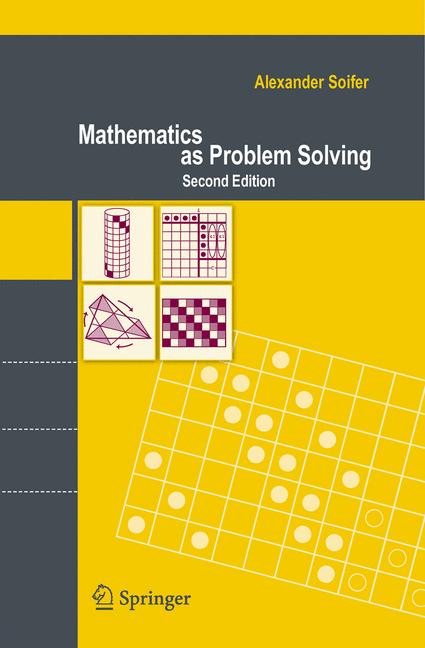
Mathematics as Problem Solving
☆☆☆☆☆
(0 reviews)
Lowest price (incl. delivery)
83,99 USD
Typical price55,62 PLN
Lowest (90 days)49,99 PLN
Offers6
Last updated6 giorni fa
Price history (90 days)
Full history
2026-08-08
2026-08-15
| Aggiornato il | Prezzo |
|---|---|
| 2026-08-08 | 54,99 |
| 2026-08-14 | 49,99 |
| 2026-08-15 | 58,84 |
| Venditore | Product price | Delivery | Totale | Disponibilità | Updated | |
|---|---|---|---|---|---|---|
| SP SpringerNatureLink Shop INT | 54,99 USD | 29,00 USD | 83,99 USD | Disponibile | 2 ore fa | View offer |
| SP SpringerNatureLink Shop INT | 54,99 USD | 25,00 USD | 79,99 USD | Disponibile | 2 ore fa | View offer |
| SP SpringerNatureLink Shop INT | 59,99 USD | free | 59,99 USD | Disponibile | 1 ora fa | View offer |
| SP SpringerNatureLink Shop INT | 59,99 USD | 29,00 USD | 88,99 USD | Disponibile | 1 ora fa | View offer |
| SP Springer Nature Author | 59,99 USD | free | 59,99 USD | Disponibile | 6 giorni fa | View offer |
| SP SpringerNatureLink Shop INT | 58,84 EUR | free | 58,84 EUR | Disponibile | 1 ora fa | View offer |
I prezzi e la disponibilità possono variare. Ultimo aggiornamento: 08.08.2026 11:14.
0,0
☆☆☆☆☆
0 reviews
5★
0%
4★
0%
3★
0%
2★
0%
1★
0%
Product reviews
No reviews yet — be the first!
This book joins several other books available for the preparation of young scholars for a future that involves solving mathematical pr- lems. This training not only increases their ?tness in competitions, but may also help them in other endeavors they may engage in the future. The book is a diversi?ed collection of problems from all areas of high school mathematics, and is written in a lively and engaging way. The introductory explanations and worked problems help guide the reader without turning the additional problems into rote repe- tions of the solved ones. The book should become an essential tool in the armamentarium of faculty involved with training future competitors. Branko Grunbaum ¨ Professor of Mathematics University of Washington June 2008, Seattle, Washington Foreword This was the ?rst of Alexander Soifer’s books, I think, preceding How Does One Cut a Triangle? by a few years. It is short on anecdote and reminiscence, but there is charm in its youthful brusqueness and let- get-right-to-business muscularity. And, mainly, there is a huge lode of problems, very good ones worked out and very good ones left to the reader to work out.
Similar products
 Pro ASP.NET MVC 5
from $86.40
Pro ASP.NET MVC 5
from $86.40
 Numerical Methods in Chemical Process Engineering Using Python
from $86.40
Numerical Methods in Chemical Process Engineering Using Python
from $86.40
 New Trends in Information and Communications Technology Applications
from $86.66
New Trends in Information and Communications Technology Applications
from $86.66
 Diagrammatic Representation and Inference
from $81.99
Diagrammatic Representation and Inference
from $81.99
 Advances in Cryptology – CRYPTO 2026
from $82.38
Advances in Cryptology – CRYPTO 2026
from $82.38
 Advances in Cryptology – CRYPTO 2026
from $82.38
Advances in Cryptology – CRYPTO 2026
from $82.38
 Advances in Cryptology – CRYPTO 2026
from $82.38
Advances in Cryptology – CRYPTO 2026
from $82.38
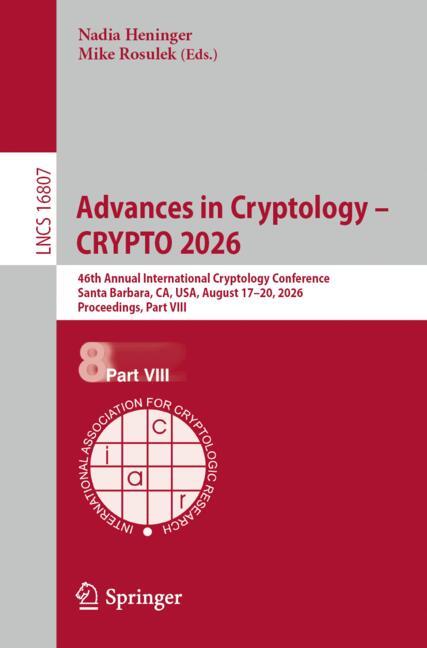 Advances in Cryptology – CRYPTO 2026
from $82.38
Advances in Cryptology – CRYPTO 2026
from $82.38