
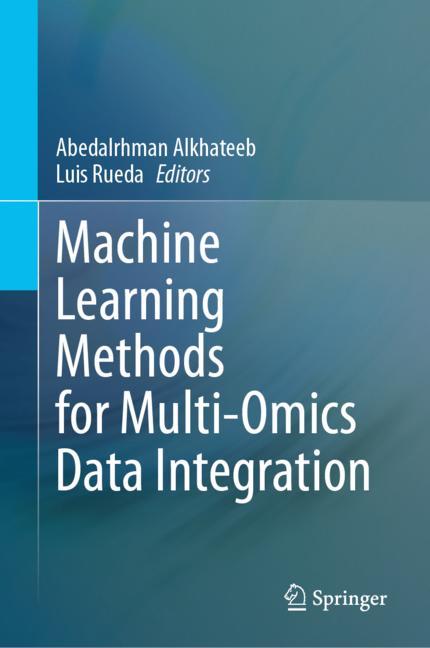
Machine Learning Methods for Multi-Omics Data Integration
☆☆☆☆☆
(0 reviews)
Lowest price (incl. delivery)
285,00 EUR
Typical price455,18 PLN
Lowest (90 days)74,70 PLN
Offers2
Last updated1 giorno fa
| Venditore | Product price | Delivery | Totale | Disponibilità | Updated | |
|---|---|---|---|---|---|---|
| SP Springer Nature Author | 260,00 EUR | 25,00 EUR | 285,00 EUR | Disponibile | 1 giorno fa | View offer |
| VI VitalSource | 1 417,41 ZAR | 25,00 ZAR | 1 442,41 ZAR | Disponibile | 1 giorno fa | View offer |
I prezzi e la disponibilità possono variare. Ultimo aggiornamento: 08.08.2026 06:47.
EAN
9783031365010
Springer Nature
0,0
☆☆☆☆☆
0 reviews
5★
0%
4★
0%
3★
0%
2★
0%
1★
0%
Product reviews
No reviews yet — be the first!
The advancement of biomedical engineering has enabled the generation of multi-omics data by developing high-throughput technologies, such as next-generation sequencing, mass spectrometry, and microarrays. Large-scale data sets for multiple omics platforms, including genomics, transcriptomics, proteomics, and metabolomics, have become more accessible and cost-effective over time. Integrating multi-omics data has become increasingly important in many research fields, such as bioinformatics, genomics, and systems biology. This integration allows researchers to understand complex interactions between biological molecules and pathways. It enables us to comprehensively understand complex biological systems, leading to new insights into disease mechanisms, drug discovery, and personalized medicine. Still, integrating various heterogeneous data types into a single learning model also comes with challenges. In this regard, learning algorithms have been vital in analyzing and integratingthese large-scale heterogeneous data sets into one learning model. This book overviews the latest multi-omics technologies, machine learning techniques for data integration, and multi-omics databases for validation. It covers different types of learning for supervised and unsupervised learning techniques, including standard classifiers, deep learning, tensor factorization, ensemble learning, and clustering, among others. The book categorizes different levels of integrations, ranging from early, middle, or late-stage among multi-view models. The underlying models target different objectives, such as knowledge discovery, pattern recognition, disease-related biomarkers, and validation tools for multi-omics data. Finally, the book emphasizes practical applications and case studies, making it an essential resource for researchers and practitioners looking to apply machine learning to their multi-omics data sets. The book covers data preprocessing, feature selection, and model evaluation, providing readers with a practical guide to implementing machine learning techniques on various multi-omics data sets.
Similar products
 Gamma Knife Neurosurgery in the Management of Intracranial Disorders
from $210.78
Gamma Knife Neurosurgery in the Management of Intracranial Disorders
from $210.78
 SDGs in Construction Economics and Organization
from $210.78
SDGs in Construction Economics and Organization
from $210.78
 Emerging Therapies in Neurorehabilitation III
from $210.78
Emerging Therapies in Neurorehabilitation III
from $210.78
 Ground Improvement Techniques
from $220.36
Ground Improvement Techniques
from $220.36
 Anomaly Detection in Video Surveillance
from $220.36
Anomaly Detection in Video Surveillance
from $220.36
 Mechanism and Machine Science
from $287.42
Mechanism and Machine Science
from $287.42
 Protein-Protein Interactions as New Drug Targets
from $287.42
Protein-Protein Interactions as New Drug Targets
from $287.42
 Proceedings of the 7th International Conference of Transportation Research Group of India (CTRG 2023
from $287.42
Proceedings of the 7th International Conference of Transportation Research Group of India (CTRG 2023
from $287.42