
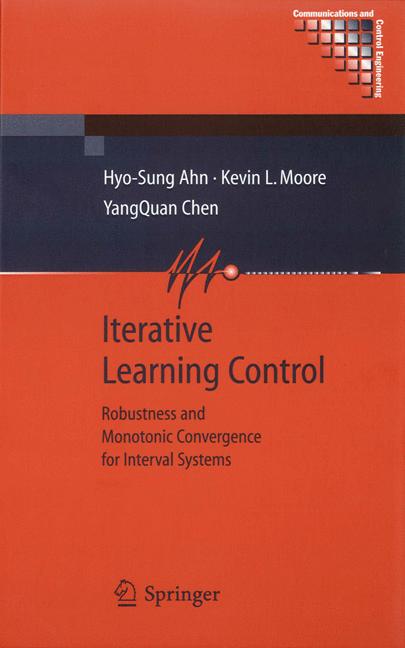
Iterative Learning Control
☆☆☆☆☆
(0 reviews)
Lowest price (incl. delivery)
109,00 USD
Typical price1 217,52 PLN
Lowest (90 days)39,99 PLN
Offers2
Last updated14 ore fa
| Venditore | Product price | Delivery | Totale | Disponibilità | Updated | |
|---|---|---|---|---|---|---|
| SP SpringerNatureLink Shop INT | 109,00 USD | free | 109,00 USD | Disponibile | 23 ore fa | View offer |
| SP Springer Nature Author | 21 449,00 JPY | 19,00 JPY | 21 468,00 JPY | Disponibile | 14 ore fa | View offer |
I prezzi e la disponibilità possono variare. Ultimo aggiornamento: 08.08.2026 23:08.
0,0
☆☆☆☆☆
0 reviews
5★
0%
4★
0%
3★
0%
2★
0%
1★
0%
Product reviews
No reviews yet — be the first!
This monograph studies the design of robust, monotonically-convergent it- ative learning controllers for discrete-time systems. Iterative learning control (ILC) is well-recognized as an e?cient method that o?ers signi?cant p- formance improvement for systems that operate in an iterative or repetitive fashion (e. g. , robot arms in manufacturing or batch processes in an industrial setting). Though the fundamentals of ILC design have been well-addressed in the literature, two key problems have been the subject of continuing - search activity. First, many ILC design strategies assume nominal knowledge of the system to be controlled. Only recently has a comprehensive approach to robust ILC analysis and design been established to handle the situation where the plant model is uncertain. Second, it is well-known that many ILC algorithms do not produce monotonic convergence, though in applications monotonic convergencecan be essential. This monograph addresses these two keyproblems by providingauni?ed analysisanddesignframeworkforrobust, monotonically-convergent ILC. The particular approach used throughout is to consider ILC design in the iteration domain, rather than in the time domain. Using a lifting technique, the two-dimensionalILC system, whichhas dynamics in both the time and - erationdomains,istransformedintoaone-dimensionalsystem,withdynamics only in the iteration domain. The so-called super-vector framework resulting from this transformation is used to analyze both robustness and monotonic convergence for typical uncertainty models, including parametric interval - certainties, frequency-like uncertainty in the iteration domain, and iterati- domain stochastic uncertainty.
Similar products
 Patient Safety Coaching
from $91.97
Patient Safety Coaching
from $91.97
 Ethnography and Diversity
from $69.30
Ethnography and Diversity
from $69.30
 Smart Villages
from $91.97
Smart Villages
from $91.97
 Nuclear Non-Proliferation in International Law - Volume VI
from $91.97
Nuclear Non-Proliferation in International Law - Volume VI
from $91.97
 The Price of Freedom
from $91.97
The Price of Freedom
from $91.97
 Eco-Social Policy in the OECD and the World Bank
from $91.97
Eco-Social Policy in the OECD and the World Bank
from $91.97
 Special Topics in Policing
from $122.58
Special Topics in Policing
from $122.58
 Music from the Heart
from $91.97
Music from the Heart
from $91.97