
Information Materials
☆☆☆☆☆
(0 reviews)
Lowest price (incl. delivery)
12 583,00 JPY
Typical price93,10 PLN
Lowest (90 days)79,50 PLN
Offers3
Last updated1 giorno fa
| Venditore | Product price | Delivery | Totale | Disponibilità | Updated | |
|---|---|---|---|---|---|---|
| SP SpringerNatureLink Shop INT | 12 583,00 JPY | free | 12 583,00 JPY | Disponibile | 1 giorno fa | View offer |
| SP SpringerNatureLink Shop INT | 104,00 EUR | free | 104,00 EUR | Disponibile | 2 giorni fa | View offer |
| SP Springer Nature Author | 104,00 EUR | free | 104,00 EUR | Disponibile | 1 settimana fa | View offer |
I prezzi e la disponibilità possono variare. Ultimo aggiornamento: 15.08.2026 07:59.
EAN
9783319351506
Springer Nature
0,0
☆☆☆☆☆
0 reviews
5★
0%
4★
0%
3★
0%
2★
0%
1★
0%
Product reviews
No reviews yet — be the first!
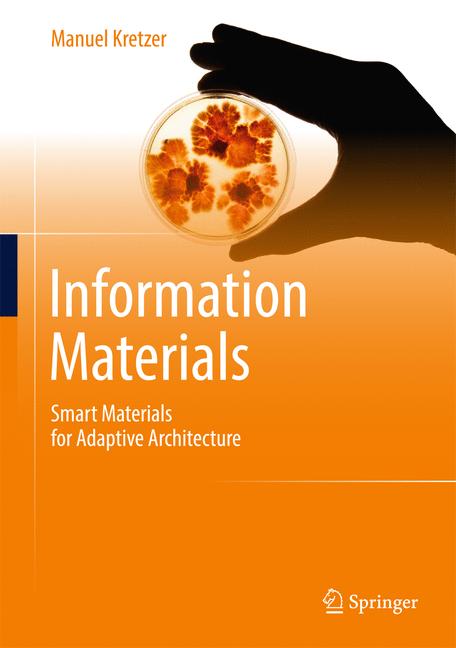
This book considers the potential of new, smart materials and their use in architecture. It begins with an overview of current global tendencies (technological, demographic, and socio-anthropological) and their relevance for architectural design. Expanding upon approaches for flexible design solutions to address change and uncertainty, Dr. Kretzer begins by exploring adaptive architecture and proceeds to introduce the topic of “information materials,” which encompasses smart and functional materials, their current usage, and their potential for the creation of future spaces. The second chapter provides a comprehensive overview of architectural materials, past and present, split into the topics: natural, industrial, synthetic, digital, and information materials. Chapter three introduces an educational approach for the mediation of information material usage in design courses and student workshops. The final section provides detailed information on a range of emerging material phenomena, including aerogels, bioluminescence, bio plastics, dye-sensitized solar cells, electroluminescent displays, electroactive polymers, soft robotics, and thermochromics. Each section explains its respective history, working principles, fabrication and (potential) usage in architecture and design, and provides hands-on tutorials on how to self-produce these materials, and displays class-tested experimental installations. The book concludes with an outlook into the domain of synthetic biology and the prospects of a “living” architecture. It is ideal for students of structural materials engineering, architecture, and urban planning; professionals working these in areas, as well as materials science/engineering and architecture educators.
Similar products
 50 Years of Philosophy and Medicine
from $107.30
50 Years of Philosophy and Medicine
from $107.30
 Understanding Cybersecurity Law and Digital Privacy
from $122.63
Understanding Cybersecurity Law and Digital Privacy
from $122.63
 Decisions in International Trade and Logistics
from $122.63
Decisions in International Trade and Logistics
from $122.63
 Advances in Economic Measurement
from $122.63
Advances in Economic Measurement
from $122.63
 Nanomaterials
from $137.96
Nanomaterials
from $137.96
 Sustainable Scaffolds-based Strategies in Tissue Engineering and Regenerative Medicine
from $162.87
Sustainable Scaffolds-based Strategies in Tissue Engineering and Regenerative Medicine
from $162.87
 Narratives in Educational Research
from $162.87
Narratives in Educational Research
from $162.87
 Environmental Biology of the Young Chinese Sturgeon
from $210.78
Environmental Biology of the Young Chinese Sturgeon
from $210.78