
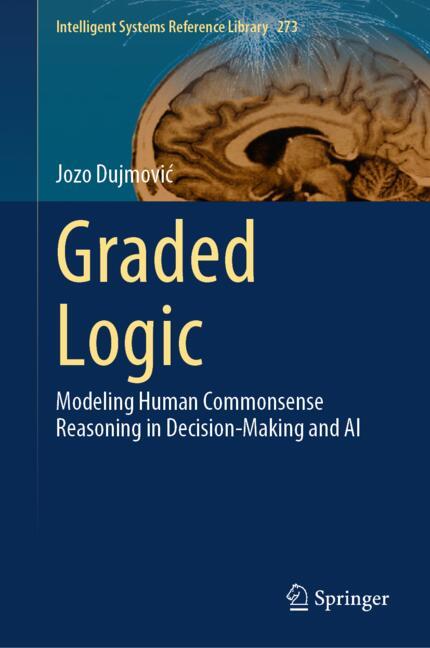
Graded Logic
☆☆☆☆☆
(0 reviews)
Lowest price (incl. delivery)
169,99 USD
Typical price172,09 PLN
Lowest (90 days)139,09 PLN
Offers6
Last updated5 giorni fa
Price history (90 days)
Full history
2026-08-08
2026-08-15
| Aggiornato il | Prezzo |
|---|---|
| 2026-08-08 | 139,09 |
| 2026-08-15 | 149,99 |
| Venditore | Product price | Delivery | Totale | Disponibilità | Updated | |
|---|---|---|---|---|---|---|
| SP SpringerNatureLink Shop INT | 169,99 USD | free | 169,99 USD | Disponibile | 5 giorni fa | View offer |
| SP SpringerNatureLink Shop INT | 169,99 USD | 25,00 USD | 194,99 USD | Disponibile | 5 giorni fa | View offer |
| SP SpringerNatureLink Shop INT | 199,99 USD | free | 199,99 USD | Disponibile | 5 giorni fa | View offer |
| SP SpringerNatureLink Shop INT | 199,99 USD | 29,00 USD | 228,99 USD | Disponibile | 5 giorni fa | View offer |
| SP Springer Nature Author | 199,99 USD | free | 199,99 USD | Disponibile | 1 settimana fa | View offer |
| SP SpringerNatureLink Shop INT | 186,99 EUR | 29,00 EUR | 215,99 EUR | Disponibile | 5 giorni fa | View offer |
I prezzi e la disponibilità possono variare. Ultimo aggiornamento: 15.08.2026 06:38.
0,0
☆☆☆☆☆
0 reviews
5★
0%
4★
0%
3★
0%
2★
0%
1★
0%
Product reviews
No reviews yet — be the first!
Observable human commonsense reasoning can be modeled with graded propositional logic. Our approach is distinctive in that all mathematical models are directly linked to specific, observable, and explainable mental activities. Decision-makers evaluate alternatives through perceived gradations of truth, importance, suitability, simultaneity, and substitutability. Each graded variable has a semantic identity, reflecting its role and meaning tied to the goals and interests of a specific decision-maker. Graded logic was introduced 50 years ago, and this book presents its current status based on a half-century of improvements and applications. The book includes examples of decision problems solved using graded logic models. Our aim is to provide readers with a solid theoretical foundation in graded propositional calculus, enabling them to confidently apply the LSP method on complex evaluation and decision problems. Additionally, the book suggests numerous directions for future research and applications.
Similar products
 50 Years of Philosophy and Medicine
from $107.30
50 Years of Philosophy and Medicine
from $107.30
 Understanding Cybersecurity Law and Digital Privacy
from $122.63
Understanding Cybersecurity Law and Digital Privacy
from $122.63
 Decisions in International Trade and Logistics
from $122.63
Decisions in International Trade and Logistics
from $122.63
 Advances in Economic Measurement
from $122.63
Advances in Economic Measurement
from $122.63
 Nanomaterials
from $137.96
Nanomaterials
from $137.96
 Sustainable Scaffolds-based Strategies in Tissue Engineering and Regenerative Medicine
from $162.87
Sustainable Scaffolds-based Strategies in Tissue Engineering and Regenerative Medicine
from $162.87
 Narratives in Educational Research
from $162.87
Narratives in Educational Research
from $162.87
 Environmental Biology of the Young Chinese Sturgeon
from $210.78
Environmental Biology of the Young Chinese Sturgeon
from $210.78