
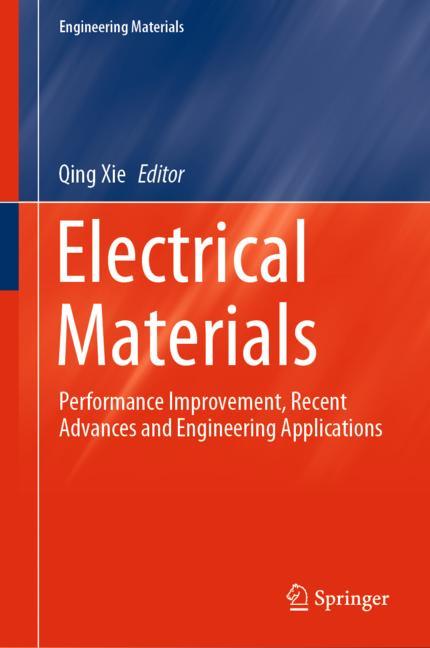
Electrical Materials
☆☆☆☆☆
(0 reviews)
Lowest price (incl. delivery)
91,80 EUR
Typical price1 630,98 PLN
Lowest (90 days)55,65 PLN
Offers3
Last updated1 settimana fa
Price history (90 days)
Full history
2026-08-08
2026-08-15
| Aggiornato il | Prezzo |
|---|---|
| 2026-08-08 | 62,30 |
| 2026-08-15 | 55,65 |
| Venditore | Product price | Delivery | Totale | Disponibilità | Updated | |
|---|---|---|---|---|---|---|
| SP SpringerNatureLink Shop INT | 72,80 EUR | 19,00 EUR | 91,80 EUR | Disponibile | 4 giorni fa | View offer |
| SP SpringerNatureLink Shop INT | 12 583,00 JPY | free | 12 583,00 JPY | Disponibile | 4 giorni fa | View offer |
| SP Springer Nature Author | 12 583,00 JPY | 19,00 JPY | 12 602,00 JPY | Disponibile | 1 settimana fa | View offer |
I prezzi e la disponibilità possono variare. Ultimo aggiornamento: 08.08.2026 23:22.
EAN
9789819990504
Springer Nature
0,0
☆☆☆☆☆
0 reviews
5★
0%
4★
0%
3★
0%
2★
0%
1★
0%
Product reviews
No reviews yet — be the first!
This book highlights the latest advances in advanced insulating materials. Energy crisis and environmental pollution are two major themes currently faced by the human society. It is of unprecedented strategic importance to construct a strong smart grid with super/ultra-high voltage network as the backbone and clean energy transmission as the leading force. However, the performance of electrical equipment and devices is greatly determined by the properties of their insulating materials, especially when they have to work in extreme circumstances including high-temperature differences, intense radiation, and strong electric fields. The key advantage of polymers is that their properties could be adjusted by changing their chemical composition and molecular structure. Research on polymer insulating materials has been highly successful as progress has been made in characterizing these properties, designing molecular structures, and studying polymers’ specialized properties. On the other hand, nanodielectrics are prepared by adding certain nanoscale fillers into a polymer matrix to yield better electrical, thermal, and mechanical properties. When the particle pretreatment methods and the content or category of fillers are adjusted, nanodielectrics tend to have greater breakdown strength as well as better high-temperature resistance and space charge suppression. Therefore, this book covers investigations of properties of insulating materials that explore their interface effects and composite structures and introduces findings in methods that improve the performance of electrical devices. The book is not only used as a timely reference for engineering and technical personnel in related fields but also as a comprehensive textbook for college students.
Similar products
 50 Years of Philosophy and Medicine
from $107.30
50 Years of Philosophy and Medicine
from $107.30
 Understanding Cybersecurity Law and Digital Privacy
from $122.63
Understanding Cybersecurity Law and Digital Privacy
from $122.63
 Decisions in International Trade and Logistics
from $122.63
Decisions in International Trade and Logistics
from $122.63
 Advances in Economic Measurement
from $122.63
Advances in Economic Measurement
from $122.63
 Nanomaterials
from $137.96
Nanomaterials
from $137.96
 Sustainable Scaffolds-based Strategies in Tissue Engineering and Regenerative Medicine
from $162.87
Sustainable Scaffolds-based Strategies in Tissue Engineering and Regenerative Medicine
from $162.87
 Narratives in Educational Research
from $162.87
Narratives in Educational Research
from $162.87
 Environmental Biology of the Young Chinese Sturgeon
from $210.78
Environmental Biology of the Young Chinese Sturgeon
from $210.78