
Dynamic Trip Modelling
☆☆☆☆☆
(0 reviews)
Lowest price (incl. delivery)
189,49 EUR
Typical price4 368,85 PLN
Lowest (90 days)160,49 PLN
Offers7
Last updated6 giorni fa
Price history (90 days)
Full history
2026-08-08
2026-08-15
| Aggiornato il | Prezzo |
|---|---|
| 2026-08-08 | 160,49 |
| 2026-08-15 | 179,99 |
| Venditore | Product price | Delivery | Totale | Disponibilità | Updated | |
|---|---|---|---|---|---|---|
| SP SpringerNatureLink Shop INT | 160,49 EUR | 29,00 EUR | 189,49 EUR | Disponibile | 8 ore fa | View offer |
| SP SpringerNatureLink Shop INT | 28 599,00 JPY | free | 28 599,00 JPY | Disponibile | 6 ore fa | View offer |
| SP Springer Nature Author | 28 599,00 JPY | free | 28 599,00 JPY | Disponibile | 6 giorni fa | View offer |
| SP SpringerNatureLink Shop INT | 199,99 USD | 25,00 USD | 224,99 USD | Disponibile | 7 ore fa | View offer |
| SP SpringerNatureLink Shop INT | 219,99 USD | free | 219,99 USD | Disponibile | 7 ore fa | View offer |
| SP SpringerNatureLink Shop INT | 219,99 USD | 29,00 USD | 248,99 USD | Disponibile | 7 ore fa | View offer |
| SP SpringerNatureLink Shop INT | 236,00 EUR | 15,00 EUR | 251,00 EUR | Disponibile | 7 ore fa | View offer |
I prezzi e la disponibilità possono variare. Ultimo aggiornamento: 08.08.2026 23:35.
0,0
☆☆☆☆☆
0 reviews
5★
0%
4★
0%
3★
0%
2★
0%
1★
0%
Product reviews
No reviews yet — be the first!
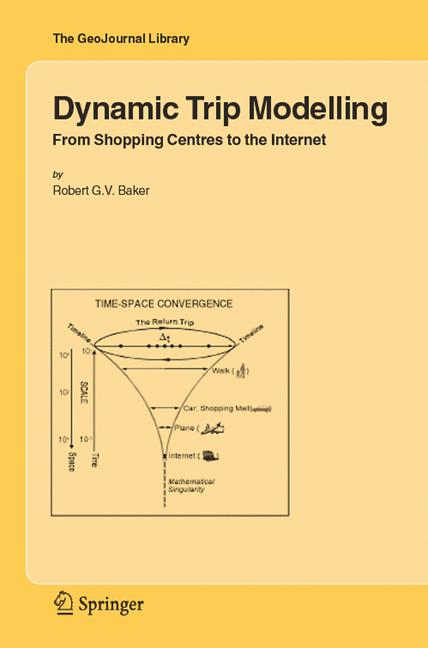
The thesis of this book is that there are one set of equations that can define any trip between an origin and destination. The idea originally came from work that I did when applying the hydrodynamic analogy to study congested traffic flows in 1981. However, I was disappointed to find out that much of the mathematical work had already been done decades earlier. When I looked for a new application, I realised that shopping centre demand could be like a longitudinal wave, governed by centre opening and closing times. Further, a solution to the differential equation was the gravity model and this suggested that time was somehow part of distance decay. This was published in 1985 and represented a different approach to spatial interaction modelling. The next step was to translate the abstract theory into something that could be tested empirically. To this end, I am grateful to my Ph. D supervisor, Professor Barry Garner who taught me that it is not sufficient just to have a theoretical model. This book is an outcome of this on-going quest to look at how the evolution of the model performs against real world data. This is a far more difficult process than numerical simulations, but the results have been more valuable to policy formulation, and closer to what I think is spatial science. The testing and application of the model required the compilation of shopping centre surveys and an Internet data set.
Similar products
 50 Years of Philosophy and Medicine
from $107.30
50 Years of Philosophy and Medicine
from $107.30
 Understanding Cybersecurity Law and Digital Privacy
from $122.63
Understanding Cybersecurity Law and Digital Privacy
from $122.63
 Decisions in International Trade and Logistics
from $122.63
Decisions in International Trade and Logistics
from $122.63
 Advances in Economic Measurement
from $122.63
Advances in Economic Measurement
from $122.63
 Nanomaterials
from $137.96
Nanomaterials
from $137.96
 Sustainable Scaffolds-based Strategies in Tissue Engineering and Regenerative Medicine
from $162.87
Sustainable Scaffolds-based Strategies in Tissue Engineering and Regenerative Medicine
from $162.87
 Narratives in Educational Research
from $162.87
Narratives in Educational Research
from $162.87
 Environmental Biology of the Young Chinese Sturgeon
from $210.78
Environmental Biology of the Young Chinese Sturgeon
from $210.78