
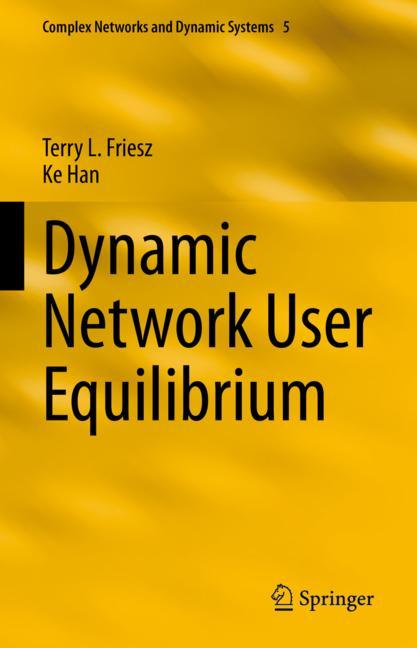
Dynamic Network User Equilibrium
☆☆☆☆☆
(0 reviews)
Lowest price (incl. delivery)
14 890,00 JPY
Typical price7 496,75 PLN
Lowest (90 days)122,50 PLN
Offers3
Last updated1 settimana fa
| Venditore | Product price | Delivery | Totale | Disponibilità | Updated | |
|---|---|---|---|---|---|---|
| SP SpringerNatureLink Shop INT | 14 871,00 JPY | 19,00 JPY | 14 890,00 JPY | Disponibile | 4 giorni fa | View offer |
| SP Springer Nature Author | 14 871,00 JPY | 25,00 JPY | 14 896,00 JPY | Disponibile | 1 settimana fa | View offer |
| SP SpringerNatureLink Shop INT | 122,50 EUR | free | 122,50 EUR | Disponibile | 5 giorni fa | View offer |
I prezzi e la disponibilità possono variare. Ultimo aggiornamento: 08.08.2026 23:26.
EAN
9783031255649
Springer Nature
0,0
☆☆☆☆☆
0 reviews
5★
0%
4★
0%
3★
0%
2★
0%
1★
0%
Product reviews
No reviews yet — be the first!
This book presents advanced research in a relatively new field of scholarly inquiry that is usually referred to as dynamic network user equilibrium, now almost universally abbreviated as DUE. It provides the first synthesis of results obtained over the last decade from applying the differential variational inequality (DVI) formalism to study the DUE problem. In particular, it explores the intimately related problem of dynamic network loading, which determines the arc flows and effective travel delays (or generalized travel costs) arising from the expression of departure rates at the origins of commuter trips between the workplace and home. In particular, the authors show that dynamic network loading with spillback of queues into upstream arcs may be formulated as a differential algebraic equation system. They demonstrate how the dynamic network loading problem and the dynamic traffic user equilibrium problem may be solved simultaneously rather than sequentially, as well as how the first-in-first-out queue discipline may be maintained for each when Lighthill-Whitham-Richardson traffic flow theory is used. A number of recent and new extensions of the DVI-based theory of DUE and corresponding examples are presented and discussed. Relevant mathematical background material is provided to make the book as accessible as possible.
Similar products
 50 Years of Philosophy and Medicine
from $107.30
50 Years of Philosophy and Medicine
from $107.30
 Understanding Cybersecurity Law and Digital Privacy
from $122.63
Understanding Cybersecurity Law and Digital Privacy
from $122.63
 Decisions in International Trade and Logistics
from $122.63
Decisions in International Trade and Logistics
from $122.63
 Advances in Economic Measurement
from $122.63
Advances in Economic Measurement
from $122.63
 Nanomaterials
from $137.96
Nanomaterials
from $137.96
 Sustainable Scaffolds-based Strategies in Tissue Engineering and Regenerative Medicine
from $162.87
Sustainable Scaffolds-based Strategies in Tissue Engineering and Regenerative Medicine
from $162.87
 Narratives in Educational Research
from $162.87
Narratives in Educational Research
from $162.87
 Environmental Biology of the Young Chinese Sturgeon
from $210.78
Environmental Biology of the Young Chinese Sturgeon
from $210.78